臲 (niè) means "Unsteady; precarious." in Chinese. It has 16 strokes with the radical 自.
Rated 3.9/5 in difficulty (challenging).
Appears in 3+ common words including 臲卼 (niè wù), 臲卼不安 (niè wù bù ān), 臲然 (niè rán).
Due to its 16 strokes, Hanzi Writer's error detection shows 臲 requires focused practice — most learners need 10+ attempts for consistent accuracy.
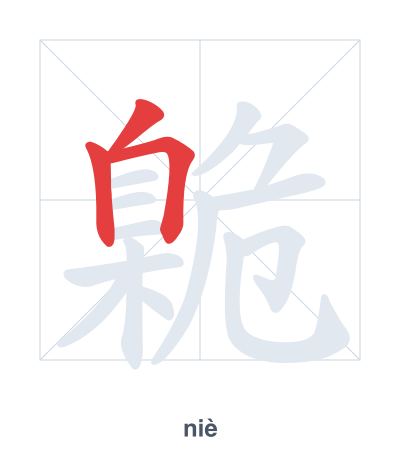
Open Hanzi Writer to see the animated stroke order and practice writing 臲 with real-time feedback.
The character 臲 (niè) is written with 16 strokes. Follow the standard Chinese stroke order: top to bottom, left to right, outside before inside. The radical 自 is one of its key components.
Practice the correct stroke order with the Hanzi Writer app to see animated stroke-by-stroke guidance with real-time feedback.
臲 means Unsteady; precarious..
| Character | 臲 |
| Pinyin | niè (nie) |
| Meaning | Unsteady; precarious. |
| Strokes | 16 |
| Radical | 自 |
| Difficulty | 3.9/5 |
臲 combines 自 (self/nose) with 埶 (which contains 丸 ball and 土 earth), suggesting a ball on earth — inherently unstable. This compound character visually depicts something resting precariously, as if a nose balanced on a wobbling ball.
💡 Memory Tip: Picture a nose (自) perched on a wobbly ball (丸) on the ground (土), teetering dangerously — that's 臲, meaning unsteady.
局势十分臲卼。
jú shì shí fēn niè wù
The situation is very unstable.
这让人感到臲卼不安。
zhè ràng rén gǎn dào niè wù bù ān
This makes people feel uneasy and unstable.
桌子臲然不稳。
zhuō zi niè rán bù wěn
The table is shaky and unstable.
Open Hanzi Writer to see the animated stroke order and practice writing 臲 with real-time feedback.
✨ Animated stroke order · Handwriting recognition · HSK-graded practice · Free to use
臲 is composed of the radical 自 (self/nose) on the left and the component 臬 (target/standard) on the right. The combination suggests an unstable situation where one's own standard or position is unsteady, giving the meaning 'precarious'.