辇 (niǎn) means "Imperial carriage" in Chinese. It has 12 strokes with the radical 车.
Rated 4.2/5 in difficulty (advanced).
Appears in 3+ common words including 步辇 (bù niǎn), 辇车 (niǎn chē), 宫辇 (gōng niǎn).
Due to its 12 strokes, Hanzi Writer's error detection shows 辇 requires focused practice — most learners need 10+ attempts for consistent accuracy.
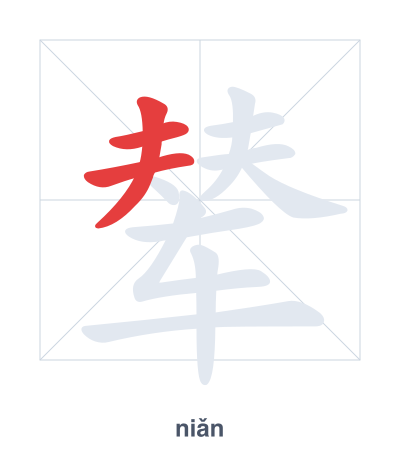
Open Hanzi Writer to see the animated stroke order and practice writing 辇 with real-time feedback.
The character 辇 (niǎn) is written with 12 strokes. Follow the standard Chinese stroke order: top to bottom, left to right, outside before inside. The radical 车 is one of its key components.
Practice the correct stroke order with the Hanzi Writer app to see animated stroke-by-stroke guidance with real-time feedback.
辇 means Imperial carriage.
辇 combines 车 (cart) with two 夫 (men) side by side, depicting two people pulling an imperial carriage. In ancient form, it showed two figures yoked to a vehicle, emphasizing human labor rather than horses.
💡 Memory Tip: Imagine two muscular men (夫夫) straining to pull a luxury car (车) for the emperor.
皇帝坐着步辇出宫。
huáng dì zuò zhe bù niǎn chū gōng
The Emperor left the palace in a sedan chair.
辇车在小路上行驶。
niǎn chē zài xiǎo lù shàng xíng shǐ
The imperial carriage is traveling on the path.
宫辇看起来很华丽。
gōng niǎn kàn qǐ lái hěn huá lì
The imperial carriage looks very gorgeous.
Open Hanzi Writer to see the animated stroke order and practice writing 辇 with real-time feedback.
✨ Animated stroke order · Handwriting recognition · HSK-graded practice · Free to use
辇 is made of two '夫' (meaning man or husband) on top and '车' (meaning vehicle) below. This structure shows two men pulling a cart, which was an ancient form of imperial carriage. So the character visually represents the idea of a human-powered royal vehicle.