蓦 (mò) means "suddenly" in Chinese. It has 13 strokes with the radical 艹.
Rated 4.2/5 in difficulty (advanced).
Appears in 3+ common words including 蓦然 (mò rán), 蓦地 (mò dì), 蓦直 (mò zhí).
Due to its 13 strokes, Hanzi Writer's error detection shows 蓦 requires focused practice — most learners need 10+ attempts for consistent accuracy.
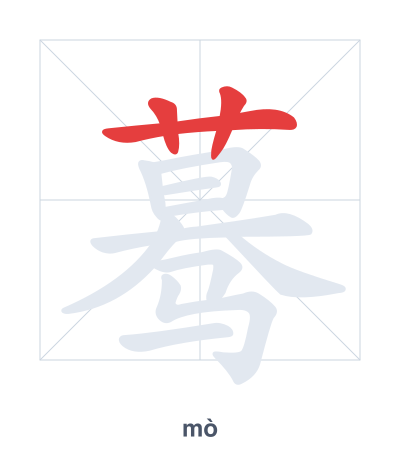
Open Hanzi Writer to see the animated stroke order and practice writing 蓦 with real-time feedback.
The character 蓦 (mò) is written with 13 strokes. Follow the standard Chinese stroke order: top to bottom, left to right, outside before inside. The radical 艹 is one of its key components.
Practice the correct stroke order with the Hanzi Writer app to see animated stroke-by-stroke guidance with real-time feedback.
蓦 means suddenly.
蓦 is a compound of 艹 (grass) on top and 莫 (dusk, also phonetic) below. The original character 驀 featured a horse (馬) and meant 'to mount a horse suddenly,' but the simplified form uses grass to evoke a scene where darkness suddenly falls over the grass at dusk. This captures the idea of a swift, unexpected change or appearance.
💡 Memory Tip: Picture a horse hidden in the grass(艹)that suddenly bursts out—the grass flies up as '莫' (a stand-in for the horse) leaps forward without warning.
他蓦然想起了往事。
tā mò rán xiǎng qǐ le wǎng shì
He suddenly remembered the past.
天蓦地阴了下来。
tiān mò dì yīn le xià lái
The sky suddenly clouded over.
请蓦直往前走。
qǐng mò zhí wǎng qián zǒu
Please go straight ahead.
Open Hanzi Writer to see the animated stroke order and practice writing 蓦 with real-time feedback.
✨ Animated stroke order · Handwriting recognition · HSK-graded practice · Free to use
蓦 is made of 艹 (grass radical) on top and 莫 beneath. The bottom part 莫 means 'do not' or 'none,' but combined with grass it creates the idea of something suddenly appearing, like grass unexpectedly emerging. This structural combination supports the meaning of 'suddenly.'