湣 (mǐn) means "To commiserate or mourn." in Chinese. It has 12 strokes with the radical 氵.
Rated 4.2/5 in difficulty (advanced).
Appears in 3+ common words including 湣王 (mǐn wáng), 哀湣 (āi mǐn), 湣乱 (mǐn luàn).
Due to its 12 strokes, Hanzi Writer's error detection shows 湣 requires focused practice — most learners need 10+ attempts for consistent accuracy.
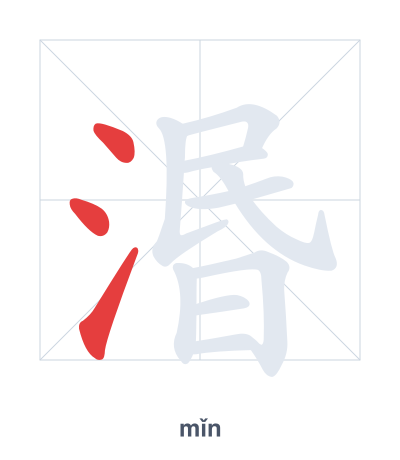
Open Hanzi Writer to see the animated stroke order and practice writing 湣 with real-time feedback.
The character 湣 (mǐn) is written with 12 strokes. Follow the standard Chinese stroke order: top to bottom, left to right, outside before inside. The radical 氵 is one of its key components.
Practice the correct stroke order with the Hanzi Writer app to see animated stroke-by-stroke guidance with real-time feedback.
湣 means To commiserate or mourn..
The character 湣 combines the water radical 氵 (indicating tears or sorrow) with 昬 (hūn, meaning dusk or darkness), where 昬 also provides a phonetic hint. Together, the components evoke the image of shedding tears in dark, gloomy times, directly linking to the meaning of mourning or commiseration.
💡 Memory Tip: Imagine a dark, rainy day (氵) where the sky is so gloomy it looks like someone's face (昬) crying over a loss.
齐湣王很有名。
qí mǐn wáng hěn yǒu míng
King Min of Qi is very famous.
他的心充满了哀湣。
tā de xīn chōng mǎn le āi mǐn
His heart is full of sorrow.
那个时代很湣乱。
nà ge shí dài hěn mǐn luàn
That era was chaotic.
Open Hanzi Writer to see the animated stroke order and practice writing 湣 with real-time feedback.
✨ Animated stroke order · Handwriting recognition · HSK-graded practice · Free to use
湣 is made of the water radical 氵 on the left and 昬 (dusk) on the right. The water radical does not directly connect to the meaning 'to mourn'; rather, the character is a phonetic loan. The right part 昬 gives a hint to the pronunciation, though modern pinyin is mǐn.