藐 (miǎo) means "small; to despise" in Chinese. It has 17 strokes with the radical 艹.
Rated 4.2/5 in difficulty (advanced).
Appears in 3+ common words including 藐视 (miǎo shì), 藐小 (miǎo xiǎo), 藐视困难 (miǎo shì kùn nán).
Due to its 17 strokes, Hanzi Writer's error detection shows 藐 requires focused practice — most learners need 10+ attempts for consistent accuracy.
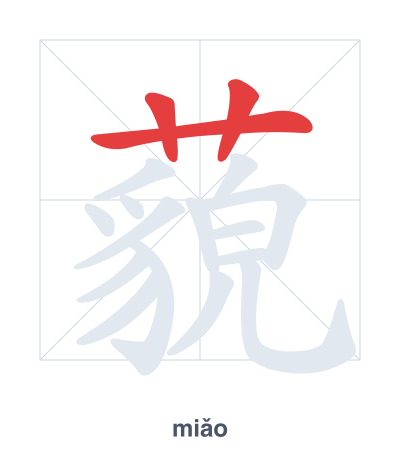
Open Hanzi Writer to see the animated stroke order and practice writing 藐 with real-time feedback.
The character 藐 (miǎo) is written with 17 strokes. Follow the standard Chinese stroke order: top to bottom, left to right, outside before inside. The radical 艹 is one of its key components.
Practice the correct stroke order with the Hanzi Writer app to see animated stroke-by-stroke guidance with real-time feedback.
藐 means small; to despise.
藐 is a phono-semantic compound: the grass radical 艹 suggests something small and insignificant, while 貌 (appearance) provides phonetic hint. Its meanings 'small' and 'to despise' stem from viewing something as trivial as a blade of grass.
💡 Memory Tip: Imagine a rabbit's face (貌) with a tiny blade of grass (艹) sticking out of its nose—so ridiculously small you despise it.
不要藐视你的对手。
bú yào miǎo shì nǐ de duì shǒu
Don't underestimate your opponent.
个人是非常藐小的。
gè rén shì fēi cháng miǎo xiǎo de
An individual is extremely tiny.
我们要藐视困难。
wǒ men yào miǎo shì kùn nán
We should look down on difficulties.
Open Hanzi Writer to see the animated stroke order and practice writing 藐 with real-time feedback.
✨ Animated stroke order · Handwriting recognition · HSK-graded practice · Free to use
藐 is composed of the grass radical 艹 on top and 貌 (appearance) below. The grass radical suggests something small like a tiny plant, while 貌 hints at the idea of how something appears, connecting to the meaning of looking down on something as insignificant.