祢 (mí) means "You (honorific used for a deity)" in Chinese. It has 9 strokes with the radical 礻.
Rated 4/5 in difficulty (challenging).
Appears in 3+ common words including 祢 (mí), 感谢祢 (gǎn xiè mí), 属于祢 (shǔ yú mí).
Due to its 9 strokes, Hanzi Writer's error detection shows 祢 requires focused practice — most learners need 10+ attempts for consistent accuracy.
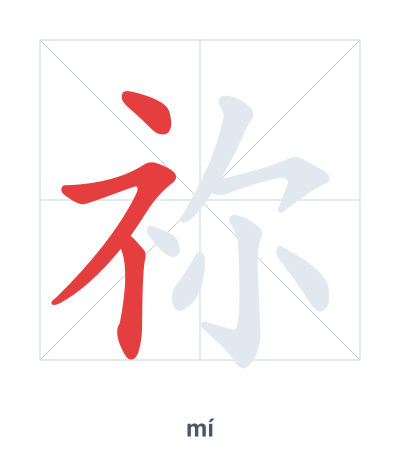
Open Hanzi Writer to see the animated stroke order and practice writing 祢 with real-time feedback.
The character 祢 (mí) is written with 9 strokes. Follow the standard Chinese stroke order: top to bottom, left to right, outside before inside. The radical 礻 is one of its key components.
Practice the correct stroke order with the Hanzi Writer app to see animated stroke-by-stroke guidance with real-time feedback.
祢 means You (honorific used for a deity).
祢 is a phono-semantic compound. The radical 礻 (示) indicates connection to deities or spirits, while 尔 provides the phonetic element and also contributes the meaning of 'you'. Together, it forms a respectful honorific 'you' used when addressing a god or divine being.
💡 Memory Tip: Picture a divine altar (礻) with a tiny 'you' (尔) carved into it, showing the reverent way to speak to a deity.
我们赞美祢。
wǒ men zàn měi mí
We praise You.
感谢祢的爱。
gǎn xiè mí de ài
Thank You for Your love (to God).
这一切都属于祢。
zhè yī qiè dōu shǔ yú mí
All of this belongs to You (God).
Open Hanzi Writer to see the animated stroke order and practice writing 祢 with real-time feedback.
✨ Animated stroke order · Handwriting recognition · HSK-graded practice · Free to use
The left component is 礻, the radical for spirits or deities. The right component is 尔, which means 'you' and also provides the pronunciation mí. Together, they form a character meaning 'you' but specifically used when addressing a deity with respect.