檬 (méng) means "lemon (used in 檸檬)" in Chinese. It has 17 strokes with the radical 木.
Rated 4.2/5 in difficulty (advanced).
Appears in 3+ common words including 柠檬 (níng méng), 柠檬水 (níng méng shuǐ), 柠檬片 (níng méng piàn).
Due to its 17 strokes, Hanzi Writer's error detection shows 檬 requires focused practice — most learners need 10+ attempts for consistent accuracy.
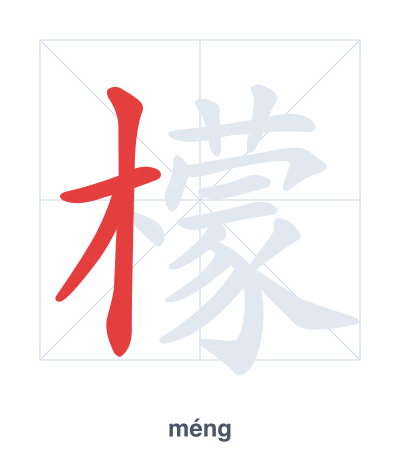
Open Hanzi Writer to see the animated stroke order and practice writing 檬 with real-time feedback.
The character 檬 (méng) is written with 17 strokes. Follow the standard Chinese stroke order: top to bottom, left to right, outside before inside. The radical 木 is one of its key components.
Practice the correct stroke order with the Hanzi Writer app to see animated stroke-by-stroke guidance with real-time feedback.
檬 means lemon (used in 檸檬).
檬 is a phono-semantic compound combining the tree radical 木 (mù, 'wood/tree') with the phonetic component 蒙 (méng, which also means 'to cover'). It appears in the word 檸檬 (níngméng) meaning 'lemon', referring to the citrus tree that produces the fruit.
💡 Memory Tip: Imagine a lemon tree (木) wearing a blindfold (蒙) because the sour fruit is so sharp it makes you want to cover your eyes.
柠檬的味道很酸。
níng méng de wèi dào hěn suān
Lemons taste very sour.
我想喝一杯柠檬水。
wǒ xiǎng hē yī bēi níng méng shuǐ
I want to drink a glass of lemonade.
水里放了两片柠檬片。
shuǐ lǐ fàng le liǎng piàn níng méng piàn
Two lemon slices were put in the water.
Open Hanzi Writer to see the animated stroke order and practice writing 檬 with real-time feedback.
✨ Animated stroke order · Handwriting recognition · HSK-graded practice · Free to use
The character 檬 is made of the radical 木 (wood/tree) on the left and 蒙 (méng) on the right. The 木 radical shows that the character is related to trees or plants, and 蒙 provides the pronunciation. Together, they form a character used specifically for the lemon plant.