槭 (qī) means "Maple" in Chinese. It has 15 strokes with the radical 木.
Rated 4.2/5 in difficulty (advanced).
Appears in 3+ common words including 槭树 (qī shù), 槭叶 (qī yè), 红槭 (hóng qī).
Due to its 15 strokes, Hanzi Writer's error detection shows 槭 requires focused practice — most learners need 10+ attempts for consistent accuracy.
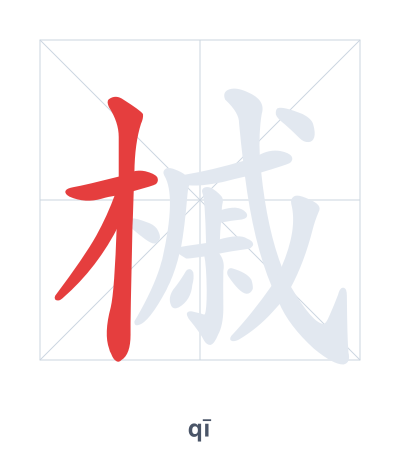
Open Hanzi Writer to see the animated stroke order and practice writing 槭 with real-time feedback.
The character 槭 (qī) is written with 15 strokes. Follow the standard Chinese stroke order: top to bottom, left to right, outside before inside. The radical 木 is one of its key components.
Practice the correct stroke order with the Hanzi Writer app to see animated stroke-by-stroke guidance with real-time feedback.
槭 means Maple.
槭 is a phono-semantic compound character. The radical 木 (tree) indicates it is a type of tree, while 戚 (qī) provides the pronunciation and originally meant 'relatives' or 'sorrow,' but here acts purely as a phonetic component with no direct semantic link to maple.
💡 Memory Tip: Picture a sad relative (戚) leaning against a maple tree (木) because its leaves turn red and fall in autumn, making them weep.
秋天到了,槭树叶红了。
qiū tiān dào le qī shù yè hóng le
Autumn has arrived, and the maple leaves have turned red.
我捡了一片红色的槭叶。
wǒ jiǎn le yī piàn hóng sè de qī yè
I picked up a red maple leaf.
院子里种了一棵红槭。
yuàn zi lǐ zhǒng le yī kē hóng qī
A red maple tree is planted in the yard.
Open Hanzi Writer to see the animated stroke order and practice writing 槭 with real-time feedback.
✨ Animated stroke order · Handwriting recognition · HSK-graded practice · Free to use
The character 槭 is made of two parts: the left side 木 (tree radical) and the right side 戚 (qī). The tree radical tells you this character is related to a type of tree, and the right side gives the pronunciation qī. Together they form the word for "maple tree."