骡 (luó) means "Mule" in Chinese. It has 14 strokes with the radical 马.
Rated 4.2/5 in difficulty (advanced).
Appears in 3+ common words including 骡子 (luó zi), 骡马 (luó mǎ), 骡车 (luó chē).
Due to its 14 strokes, Hanzi Writer's error detection shows 骡 requires focused practice — most learners need 10+ attempts for consistent accuracy.
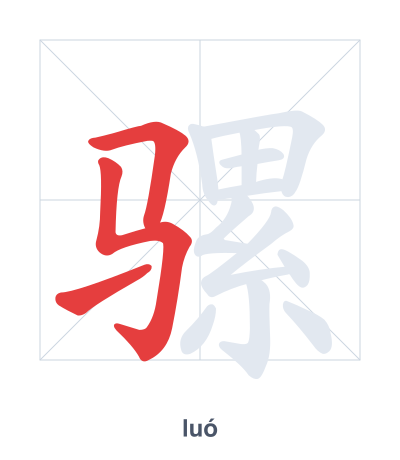
Open Hanzi Writer to see the animated stroke order and practice writing 骡 with real-time feedback.
The character 骡 (luó) is written with 14 strokes. Follow the standard Chinese stroke order: top to bottom, left to right, outside before inside. The radical 马 is one of its key components.
Practice the correct stroke order with the Hanzi Writer app to see animated stroke-by-stroke guidance with real-time feedback.
骡 means Mule.
骡 is a phono-semantic compound. The left radical 马 (horse) indicates the animal belongs to the horse family, while the right component 累 (léi) provides the pronunciation and conceptually suggests a hybrid that 'accumulates' traits from both a horse and a donkey.
💡 Memory Tip: Picture a horse (马) that is so exhausted (累) from its hybrid genes that it plods along like a mule.
骡子在山路上拉车。
luó zi zài shān lù shàng lā chē
The mule is pulling a cart on the mountain road.
市场上有很多骡马。
shì chǎng shàng yǒu hěn duō luó mǎ
There are many mules and horses in the market.
他坐着骡车回村子。
tā zuò zhe luó chē huí cūn zi
He is returning to the village by mule cart.
Open Hanzi Writer to see the animated stroke order and practice writing 骡 with real-time feedback.
✨ Animated stroke order · Handwriting recognition · HSK-graded practice · Free to use
The left side is 马, the horse radical, showing that a mule is related to horses. The right side is 累 (lěi), which provides the sound and also suggests "accumulate" — a mule is a strong hybrid of a horse and a donkey.