漉 (lù) means "To strain / To filter" in Chinese. It has 14 strokes with the radical 氵.
Rated 4.2/5 in difficulty (advanced).
Appears in 3+ common words including 湿漉漉 (shī lù lù), 漉网 (lù wǎng), 漉酒 (lù jiǔ).
Due to its 14 strokes, Hanzi Writer's error detection shows 漉 requires focused practice — most learners need 10+ attempts for consistent accuracy.
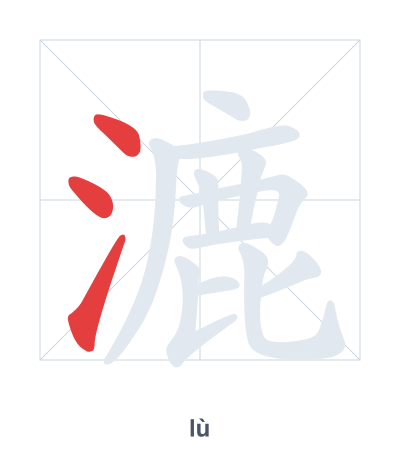
Open Hanzi Writer to see the animated stroke order and practice writing 漉 with real-time feedback.
The character 漉 (lù) is written with 14 strokes. Follow the standard Chinese stroke order: top to bottom, left to right, outside before inside. The radical 氵 is one of its key components.
Practice the correct stroke order with the Hanzi Writer app to see animated stroke-by-stroke guidance with real-time feedback.
漉 means To strain / To filter.
漉 is a phono-semantic compound: the radical 氵 (water) hints at liquid, and 鹿 (deer) gives the sound. The meaning 'to strain or filter' likely comes from the image of water seeping through a sieve, akin to how liquid might be purified by passing through animal hair or a woven screen.
💡 Memory Tip: Imagine a deer (鹿) dipping its antlers into a stream (氵) and using them like a sieve to strain out floating leaves.
他的衣服湿漉漉的。
tā de yī fú shī lù lù de
His clothes are soaking wet.
用漉网把鱼捞出来。
yòng lù wǎng bǎ yú lāo chū lái
Scoop the fish out with a strainer net.
他在尝试漉酒。
tā zài cháng shì lù jiǔ
He is trying to strain the wine.
Open Hanzi Writer to see the animated stroke order and practice writing 漉 with real-time feedback.
✨ Animated stroke order · Handwriting recognition · HSK-graded practice · Free to use
漉 is a left-right character. The left side is the water radical 氵, indicating liquid, and the right side is 鹿 (deer), which gives a hint to the pronunciation lù. Together, water and deer suggest the action of straining or filtering liquid.