轳 (lú) means "Pulley; windlass" in Chinese. It has 9 strokes with the radical 车.
Rated 4/5 in difficulty (challenging).
Appears in 3+ common words including 辘轳 (lù lú), 辘轳体 (lù lú tǐ), 辘轳剑 (lù lú jiàn).
Due to its 9 strokes, Hanzi Writer's error detection shows 轳 requires focused practice — most learners need 10+ attempts for consistent accuracy.
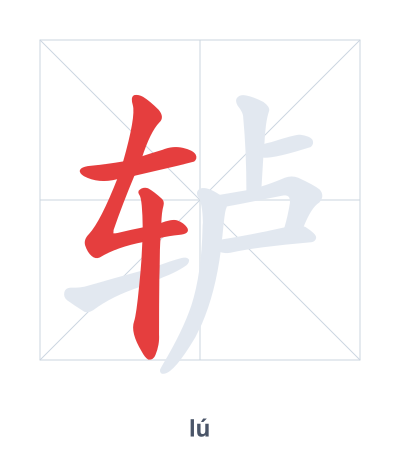
Open Hanzi Writer to see the animated stroke order and practice writing 轳 with real-time feedback.
The character 轳 (lú) is written with 9 strokes. Follow the standard Chinese stroke order: top to bottom, left to right, outside before inside. The radical 车 is one of its key components.
Practice the correct stroke order with the Hanzi Writer app to see animated stroke-by-stroke guidance with real-time feedback.
轳 means Pulley; windlass.
轳 is a phono-semantic compound combining the radical 车 (vehicle/cart) with 卢 (lú) as a phonetic component. The 车 radical indicates that the character relates to mechanical devices used with carts, such as a pulley or windlass for lifting loads.
💡 Memory Tip: Imagine a cart (车) with a big, curly hook (like the top of 卢) that winds up a rope to lift heavy buckets from a well.
井边有一个辘轳。
jǐng biān yǒu yí gè lù lú
There is a windlass by the well.
他写了一首辘轳体诗。
tā xiě le yī shǒu lù lú tǐ shī
He wrote a poem in the 'windlass' style.
他拿着一把辘轳剑。
tā ná zhe yī bǎ lù lú jiàn
He was holding a long sword.
Open Hanzi Writer to see the animated stroke order and practice writing 轳 with real-time feedback.
✨ Animated stroke order · Handwriting recognition · HSK-graded practice · Free to use
轳 consists of the radical 车 (vehicle, wheel) on the left and the phonetic component 卢 (lú) on the right. The radical 车 hints at a wheel or rotating device, which connects to the meaning of pulley or windlass. Together, the character represents a wheel-like tool used for lifting, such as a well pulley.