嵝 (lǒu) means "Lou (mountain name)" in Chinese. It has 12 strokes with the radical 山.
Rated 4.2/5 in difficulty (advanced).
Appears in 3+ common words including 岣嵝 (gǒu lǒu), 嵝山 (lǒu shān), 嵝岭 (lǒu lǐng).
Due to its 12 strokes, Hanzi Writer's error detection shows 嵝 requires focused practice — most learners need 10+ attempts for consistent accuracy.
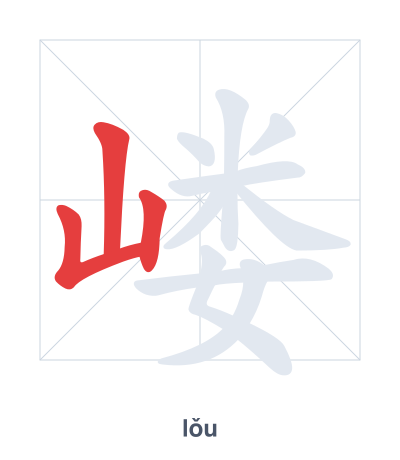
Open Hanzi Writer to see the animated stroke order and practice writing 嵝 with real-time feedback.
The character 嵝 (lǒu) is written with 12 strokes. Follow the standard Chinese stroke order: top to bottom, left to right, outside before inside. The radical 山 is one of its key components.
Practice the correct stroke order with the Hanzi Writer app to see animated stroke-by-stroke guidance with real-time feedback.
嵝 means Lou (mountain name).
嵝 is a phono-semantic compound with the radical 山 (mountain) indicating its meaning as a mountain name, and 娄 (lóu) serving as the phonetic component. It appears in the name of Mount Lou (嵝山), a specific peak.
💡 Memory Tip: Picture a mountain (山) so steep that a woman (女) must drag bags of rice (米) up it — that's Mount Lou.
岣嵝山在湖南。
gǒu lǒu shān zài hú nán
Goulou Mountain is in Hunan.
嵝山有很多树。
lǒu shān yǒu hěn duō shù
There are many trees on Lou Mountain.
嵝岭的路很难走。
lǒu lǐng de lù hěn nán zǒu
The road on Lou Ridge is difficult to walk.
Open Hanzi Writer to see the animated stroke order and practice writing 嵝 with real-time feedback.
✨ Animated stroke order · Handwriting recognition · HSK-graded practice · Free to use
嵝 is formed with the radical 山 (mountain) on the left, which tells us the meaning is related to mountains. The right side is 娄 (lóu), which gives the pronunciation lǒu and originally meant 'to drag' or 'a winnowing basket,' but here it mainly acts as a phonetic component. Together, 嵝 refers specifically to a mountain name or ridge, like in 嵝山 (Lǒu Shān).