镣 (liào) means "fetters or shackles" in Chinese. It has 17 strokes with the radical 钅.
Rated 4.2/5 in difficulty (advanced).
Appears in 3+ common words including 脚镣 (jiǎo liào), 手镣 (shǒu liào), 镣铐 (liào kào).
Due to its 17 strokes, Hanzi Writer's error detection shows 镣 requires focused practice — most learners need 10+ attempts for consistent accuracy.
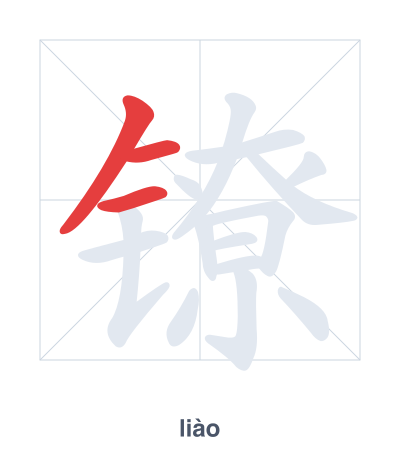
Open Hanzi Writer to see the animated stroke order and practice writing 镣 with real-time feedback.
The character 镣 (liào) is written with 17 strokes. Follow the standard Chinese stroke order: top to bottom, left to right, outside before inside. The radical 钅 is one of its key components.
Practice the correct stroke order with the Hanzi Writer app to see animated stroke-by-stroke guidance with real-time feedback.
镣 means fetters or shackles.
This character is a phono-semantic compound. The radical 钅 (gold/metal) indicates that fetters are made of metal, while the right side 尞 (liào) provides the pronunciation. The original meaning refers to heavy metal chains or shackles used to restrain prisoners.
💡 Memory Tip: Imagine a prisoner wearing massive metal shackles that look like two chains (钅) with a small fire (尞 = firewood burning) coming from the locks, showing how hot and uncomfortable the fetters are.
他戴着沉重的脚镣。
tā dài zhe chén zhòng de jiǎo liào
He is wearing heavy leg irons.
警察拿出了手镣。
jǐng chá ná chū le shǒu liào
The police took out the shackles.
镣铐限制了他的行动。
liào kào xiàn zhì le tā de xíng dòng
The shackles restricted his movement.
Open Hanzi Writer to see the animated stroke order and practice writing 镣 with real-time feedback.
✨ Animated stroke order · Handwriting recognition · HSK-graded practice · Free to use
镣 is a semantic-phonetic compound. The left component 钅 (jīn) means metal, indicating that fetters are made of metal. The right component 尞 (liào) provides the pronunciation and hints at the idea of binding.