晾 (liàng) means "To air-dry / To dry in the sun" in Chinese. It has 12 strokes with the radical 日.
Rated 4.2/5 in difficulty (advanced).
Appears in 3+ common words including 晾衣服 (liàng yī fú), 晾干 (liàng gān), 晾晒 (liàng shài).
Due to its 12 strokes, Hanzi Writer's error detection shows 晾 requires focused practice — most learners need 10+ attempts for consistent accuracy.
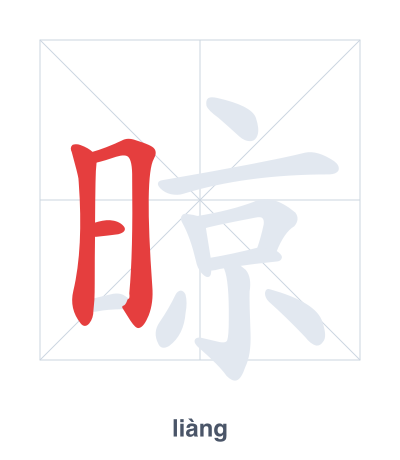
Open Hanzi Writer to see the animated stroke order and practice writing 晾 with real-time feedback.
The character 晾 (liàng) is written with 12 strokes. Follow the standard Chinese stroke order: top to bottom, left to right, outside before inside. The radical 日 is one of its key components.
Practice the correct stroke order with the Hanzi Writer app to see animated stroke-by-stroke guidance with real-time feedback.
晾 means To air-dry / To dry in the sun.
晾 is a phono-semantic compound. The radical 日 (sun) indicates that the character relates to sunlight or the sun's action. The component 京 (jīng, meaning 'capital') provides a phonetic clue to the pronunciation 'liàng'. Together, they suggest drying something under the sun, as in air-drying clothes or grains.
💡 Memory Tip: Imagine the sun (日) shining brightly over a capital city (京), where clothes are hung out to dry on every balcony.
我在阳台上晾衣服。
wǒ zài yáng tái shàng liàng yī fú
I'm hanging clothes on the balcony.
衣服已经晾干了。
yī fú yǐ jīng liàng gān le
The clothes have already air-dried.
农民在外面晾晒谷物。
nóng mín zài wài miàn liàng shài gǔ wù
Farmers are drying grain outside.
Open Hanzi Writer to see the animated stroke order and practice writing 晾 with real-time feedback.
✨ Animated stroke order · Handwriting recognition · HSK-graded practice · Free to use
晾 is made of the radical 日 (sun) on the left and 京 on the right. The 日 shows that the meaning involves sunlight, and 京 gives the sound. Together they mean 'to dry in the sun'.