Hanzi Writer

How to Write 镰 (lián) — Meaning “Sickle”

lián 18 strokes Radical: 钅

镰 (lián) means "Sickle" in Chinese. It has 18 strokes with the radical 钅.

Rated 4.2/5 in difficulty (advanced).

Appears in 3+ common words including 镰刀 (lián dāo), 镰锤 (lián chuí), 割镰 (gē lián).

Due to its 18 strokes, Hanzi Writer's error detection shows 镰 requires focused practice — most learners need 10+ attempts for consistent accuracy.
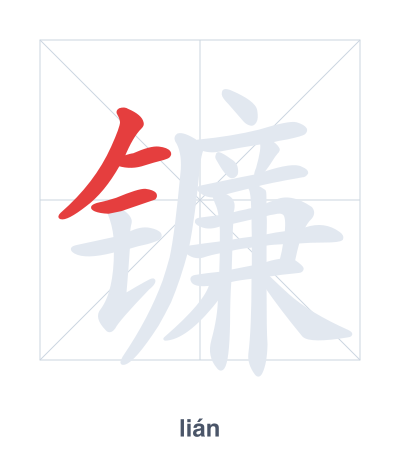
Stroke order practice for 镰 - lián

Practice Writing 镰 (lián)

Open Hanzi Writer to see the animated stroke order and practice writing 镰 with real-time feedback.

The character (lián) is written with 18 strokes. Follow the standard Chinese stroke order: top to bottom, left to right, outside before inside. The radical is one of its key components.

Practice the correct stroke order with the Hanzi Writer app to see animated stroke-by-stroke guidance with real-time feedback.

means Sickle.

Character
Pinyinlián (lian)
MeaningSickle
Strokes18
Radical
Difficulty4.2/5

镰 is a phono-semantic compound. The radical 钅 (metal) indicates the tool's material, while 廉 (lián) provides the pronunciation and suggests the sickle's curved blade resembles a humble, honest shape under a roof (广).

💡 Memory Tip: Imagine a metal sickle (钅) slicing through a cheap (廉) stack of wheat, the blade curving like the roof stroke (广) under a double harvest (兼).

lián dāo
Sickle
lián chuí
Hammer and sickle
gē lián
sickle

农民拿着镰刀割草。

nóng mín ná zhe lián dāo gē cǎo

The farmer is cutting grass with a sickle.

旗帜上有镰锤图案。

qí zhì shàng yǒu lián chuí tú àn

There is a hammer and sickle pattern on the flag.

这把割镰很锋利。

zhè bǎ gē lián hěn fēng lì

This sickle is very sharp.

Character Pinyin Strokes Radical
(current) lián 18
biāo 16
tāng 16
màn 16
Stroke order practice for 镰 - lián

Practice Writing 镰 (lián)

Open Hanzi Writer to see the animated stroke order and practice writing 镰 with real-time feedback.

✨ Animated stroke order · Handwriting recognition · HSK-graded practice · Free to use

Frequently Asked Questions about 镰

镰 is made of two parts: the left radical 钅 (metal) and the right component 廉 (lián, which gives the sound). The metal radical shows that a sickle is a tool made of metal. The right side 廉 provides the pronunciation but also hints at the tool's curved shape through its strokes.

Characters with Radical 钅

Other 18-Stroke Characters