疬 (lì) means "scrofula" in Chinese. It has 9 strokes with the radical 疒.
Rated 4/5 in difficulty (challenging).
Appears in 3+ common words including 瘰疬 (luǒ lì), 疬子 (lì zi), 疬疡 (lì yáng).
Due to its 9 strokes, Hanzi Writer's error detection shows 疬 requires focused practice — most learners need 10+ attempts for consistent accuracy.
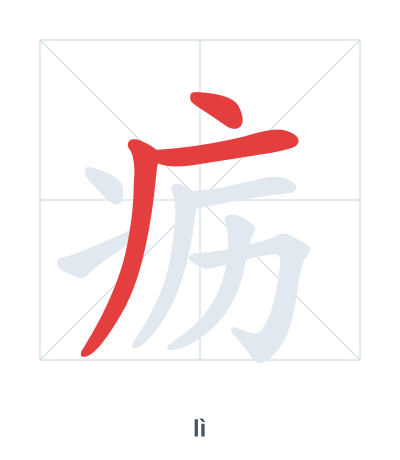
Open Hanzi Writer to see the animated stroke order and practice writing 疬 with real-time feedback.
The character 疬 (lì) is written with 9 strokes. Follow the standard Chinese stroke order: top to bottom, left to right, outside before inside. The radical 疒 is one of its key components.
Practice the correct stroke order with the Hanzi Writer app to see animated stroke-by-stroke guidance with real-time feedback.
疬 means scrofula.
疬 is a phono-semantic compound: the radical 疒 indicates disease, while 历 (lì) provides the pronunciation. Scrofula is a chronic infection causing swollen lymph nodes, often depicted as a lumpy illness. The character's structure visually combines sickness (疒) with a phonetic element (历).
💡 Memory Tip: Picture a sick person (疒) with a calendar (历) stuck to their neck, marking the days of their scrofula treatment.
医生在检查瘰疬。
yī shēng zài jiǎn chá luǒ lì
The doctor is examining the scrofula.
他脖子上有个疬子。
tā bó zi shàng yǒu gè lì zi
He has a swelling on his neck.
这种药治疬疡有效。
zhè zhǒng yào zhì lì yáng yǒu xiào
This medicine is effective in treating scrofula and skin sores.
Open Hanzi Writer to see the animated stroke order and practice writing 疬 with real-time feedback.
✨ Animated stroke order · Handwriting recognition · HSK-graded practice · Free to use
疬 is made of the radical 疒 (sickness) on the left and the phonetic component 历 (lì) on the right. The radical shows that this character relates to a disease or illness, while 历 hints at the pronunciation "lì" without adding meaning. So 疬 literally means a type of sickness called scrofula.