蜊 (lí) means "Clam" in Chinese. It has 13 strokes with the radical 虫.
Rated 4.2/5 in difficulty (advanced).
Appears in 3+ common words including 蛤蜊 (gé lí), 炒蛤蜊 (chǎo gé lí), 蛤蜊肉 (gé lí ròu).
Due to its 13 strokes, Hanzi Writer's error detection shows 蜊 requires focused practice — most learners need 10+ attempts for consistent accuracy.
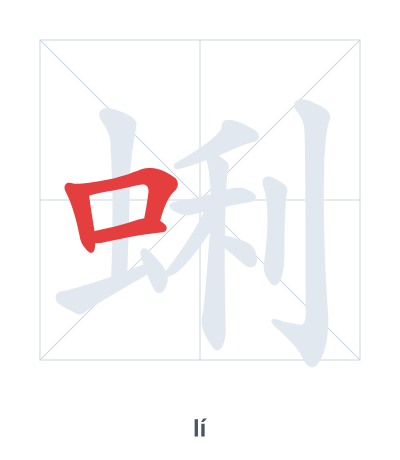
Open Hanzi Writer to see the animated stroke order and practice writing 蜊 with real-time feedback.
The character 蜊 (lí) is written with 13 strokes. Follow the standard Chinese stroke order: top to bottom, left to right, outside before inside. The radical 虫 is one of its key components.
Practice the correct stroke order with the Hanzi Writer app to see animated stroke-by-stroke guidance with real-time feedback.
蜊 means Clam.
蜊 is a phono-semantic compound: the radical 虫 (insect/creature) indicates the clam is a type of shelled animal, while the component 利 (lì, meaning 'sharp' or 'benefit') hints at the pronunciation and possibly the sharp edge of a clam's shell.
💡 Memory Tip: Picture a clam (虫) with a shell so sharp (利) that it slices open a lemon.
蛤蜊汤很好喝。
gé lí tāng hěn hǎo hē
Clam soup is very tasty.
我们去吃炒蛤蜊吧。
wǒ men qù chī chǎo gé lí ba
Let's go eat stir-fried clams.
蛤蜊肉很鲜美。
gé lí ròu hěn xiān měi
Clam meat is very delicious.
Open Hanzi Writer to see the animated stroke order and practice writing 蜊 with real-time feedback.
✨ Animated stroke order · Handwriting recognition · HSK-graded practice · Free to use
蜊 (lí) combines the radical 虫 (insect/worm) on the left and 利 (lì, sharp/benefit) on the right. The 虫 radical indicates that 蜊 belongs to the category of small creatures, specifically shellfish like clams. 利 here provides phonetic information, as both characters share the same final sound "ì" but are not directly related in meaning.