楞 (léng) means "edge / stunned" in Chinese. It has 13 strokes with the radical 木.
Rated 4.2/5 in difficulty (advanced).
Appears in 3+ common words including 发楞 (fā léng), 楞角 (léng jiǎo), 楞住 (léng zhù).
Due to its 13 strokes, Hanzi Writer's error detection shows 楞 requires focused practice — most learners need 10+ attempts for consistent accuracy.
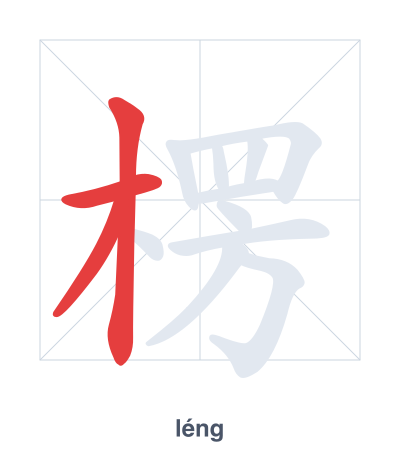
Open Hanzi Writer to see the animated stroke order and practice writing 楞 with real-time feedback.
The character 楞 (léng) is written with 13 strokes. Follow the standard Chinese stroke order: top to bottom, left to right, outside before inside. The radical 木 is one of its key components.
Practice the correct stroke order with the Hanzi Writer app to see animated stroke-by-stroke guidance with real-time feedback.
楞 means edge / stunned.
楞 is a compound character with 木 (wood) and a right component formed by 罒 (a net or eye shape) over 方 (square). This originally depicted a squared block of wood with sharp edges, giving the meaning 'edge'. The sense of 'stunned' likely arose metaphorically from the idea of being as immobile and unresponsive as a block of wood.
💡 Memory Tip: Imagine a wooden block (木) with a net (罒) draped over its square (方) edge—if you trip and hit your head on that sharp corner, you'll be completely stunned.
他坐在那里发楞。
tā zuò zài nà lǐ fā léng
He is sitting there staring blankly.
桌子的楞角很硬。
zhuō zi de léng jiǎo hěn yìng
The edges of the table are very hard.
听到消息他楞住了。
tīng dào xiāo xī tā léng zhù le
He was dumbfounded upon hearing the news.
Open Hanzi Writer to see the animated stroke order and practice writing 楞 with real-time feedback.
✨ Animated stroke order · Handwriting recognition · HSK-graded practice · Free to use
楞 is made of the wood radical 木 on the left and a right side that looks like 罒 (a net) above 方 (square). The wood radical connects to the meaning of 'edge' because wooden objects often have sharp corners. The right side provides the pronunciation léng, while the 'stunned' meaning comes from a borrowed usage similar to 愣.