畾 (léi) means "Piled stones / Fields" in Chinese. It has 15 strokes with the radical 田.
Rated 4.2/5 in difficulty (advanced).
Appears in 3+ common words including 畾落 (léi luò), 畾畾 (léi léi), 堆畾 (duī léi).
Due to its 15 strokes, Hanzi Writer's error detection shows 畾 requires focused practice — most learners need 10+ attempts for consistent accuracy.
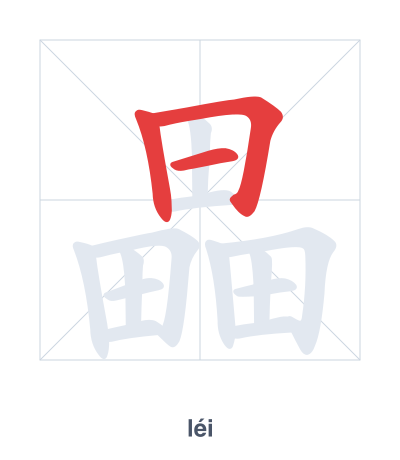
Open Hanzi Writer to see the animated stroke order and practice writing 畾 with real-time feedback.
The character 畾 (léi) is written with 15 strokes. Follow the standard Chinese stroke order: top to bottom, left to right, outside before inside. The radical 田 is one of its key components.
Practice the correct stroke order with the Hanzi Writer app to see animated stroke-by-stroke guidance with real-time feedback.
畾 means Piled stones / Fields.
畾 is a triple repetition of 田 (field), visually depicting multiple fields arranged together or stones piled up. Ancient forms may have shown stacked fields or heaps of stones, emphasizing accumulation or layering.
💡 Memory Tip: Imagine three square fields stacked on top of each other like stone blocks, forming a pile.
他的性格很畾落。
tā de xìng gé hěn léi luò
He has an upright and open personality.
果实畾畾挂满枝。
guǒ shí léi léi guà mǎn zhī
Clusters of fruit hang all over the branches.
石头堆畾在一起。
shí tou duī léi zài yì qǐ
The stones are piled up together.
Open Hanzi Writer to see the animated stroke order and practice writing 畾 with real-time feedback.
✨ Animated stroke order · Handwriting recognition · HSK-graded practice · Free to use
畾 is made of three 田 (field) radicals stacked on top of each other. The repetition of the field component suggests the idea of piling up or accumulating, which connects to its meanings of "piled stones" or "continuous fields."