蝰 (kuí) means "Viper (character component)" in Chinese. It has 15 strokes with the radical 虫.
Rated 4.2/5 in difficulty (advanced).
Appears in 3+ common words including 蝰蛇 (kuí shé), 蝰科 (kuí kē), 大蝰蛇 (dà kuí shé).
Due to its 15 strokes, Hanzi Writer's error detection shows 蝰 requires focused practice — most learners need 10+ attempts for consistent accuracy.
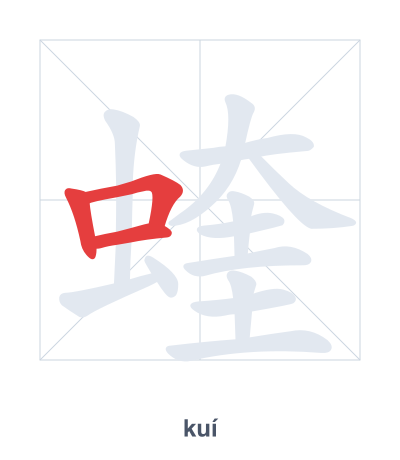
Open Hanzi Writer to see the animated stroke order and practice writing 蝰 with real-time feedback.
The character 蝰 (kuí) is written with 15 strokes. Follow the standard Chinese stroke order: top to bottom, left to right, outside before inside. The radical 虫 is one of its key components.
Practice the correct stroke order with the Hanzi Writer app to see animated stroke-by-stroke guidance with real-time feedback.
蝰 means Viper (character component).
蝰 is a phono-semantic compound: the radical 虫 (insect/snake) indicates it is a type of snake, while the right component 奎 (kuí) provides the sound. The character specifically refers to a venomous viper.
💡 Memory Tip: Picture a viper (虫) coiled around a big (大) mound of earth (土) in the crotch of a tree, ready to strike.
蝰蛇在树下休息。
kuí shé zài shù xià xiū xī
The viper is resting under the tree.
这是蝰科的一种蛇。
zhè shì kuí kē de yī zhǒng shé
This is a snake of the Viperidae family.
动物园里有一条大蝰蛇。
dòng wù yuán lǐ yǒu yī tiáo dà kuí shé
There is a big viper in the zoo.
Open Hanzi Writer to see the animated stroke order and practice writing 蝰 with real-time feedback.
✨ Animated stroke order · Handwriting recognition · HSK-graded practice · Free to use
The character 蝰 is a left-right structure. The left part 虫 is the radical meaning "creature" or "insect," indicating that 蝰 refers to an animal. The right part 奎 provides the pronunciation kuí and also suggests a type of snake, as vipers are a specific kind of reptile.