眶 (kuàng) means "eye socket" in Chinese. It has 11 strokes with the radical 目.
Rated 4.2/5 in difficulty (advanced).
Appears in 3+ common words including 眼眶 (yǎn kuàng), 热泪盈眶 (rè lèi yíng kuàng), 眶内 (kuàng nèi).
Due to its 11 strokes, Hanzi Writer's error detection shows 眶 requires focused practice — most learners need 10+ attempts for consistent accuracy.
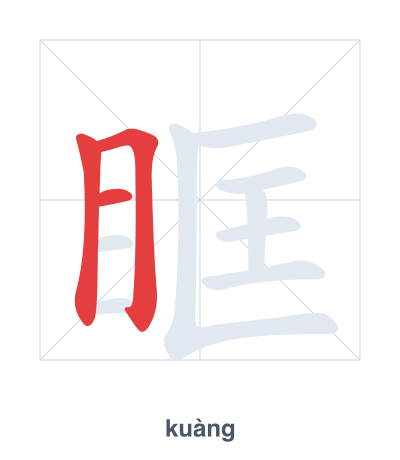
Open Hanzi Writer to see the animated stroke order and practice writing 眶 with real-time feedback.
The character 眶 (kuàng) is written with 11 strokes. Follow the standard Chinese stroke order: top to bottom, left to right, outside before inside. The radical 目 is one of its key components.
Practice the correct stroke order with the Hanzi Writer app to see animated stroke-by-stroke guidance with real-time feedback.
眶 means eye socket.
The character 眶 combines the radical 目 (eye) with the phonetic component 匡 (kuāng), which originally depicted a square container or frame. Together, they form the meaning 'eye socket'—the bony frame that encloses the eye.
💡 Memory Tip: Imagine a square picture frame (匡) placed right around an eye (目), forming the eye socket.
他的眼眶红了。
tā de yǎn kuàng hóng le
His eyes turned red.
听完故事,他热泪盈眶。
tīng wán gù shì tā rè lèi yíng kuàng
After hearing the story, his eyes filled with tears.
眼泪在眶内打转。
yǎn lèi zài kuàng nèi dǎ zhuàn
Tears are welling up in the eyes.
Open Hanzi Writer to see the animated stroke order and practice writing 眶 with real-time feedback.
✨ Animated stroke order · Handwriting recognition · HSK-graded practice · Free to use
The character 眶 is composed of the radical 目 (eye) on the left and 匡 (kuāng, meaning frame or box) on the right. Together, they suggest the "frame of the eye," which is the eye socket. This is a semantic-phonetic compound where 匡 also provides a hint to the pronunciation.