圹 (kuàng) means "Open field / Grave" in Chinese. It has 6 strokes with the radical 土.
Rated 3.2/5 in difficulty (challenging).
Appears in 3+ common words including 圹野 (kuàng yě), 墓圹 (mù kuàng), 圹垠 (kuàng yín).
Due to its 6 strokes, Hanzi Writer's error detection shows 圹 requires focused practice — most learners need 10+ attempts for consistent accuracy.
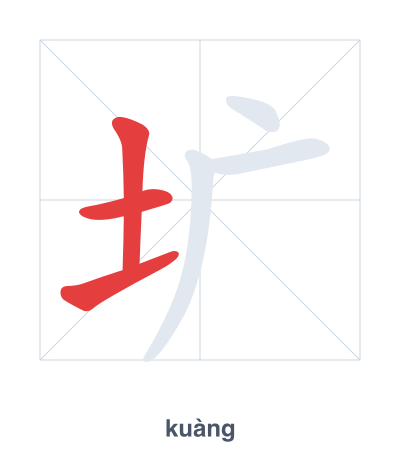
Open Hanzi Writer to see the animated stroke order and practice writing 圹 with real-time feedback.
The character 圹 (kuàng) is written with 6 strokes. Follow the standard Chinese stroke order: top to bottom, left to right, outside before inside. The radical 土 is one of its key components.
Practice the correct stroke order with the Hanzi Writer app to see animated stroke-by-stroke guidance with real-time feedback.
圹 means Open field / Grave.
The character 圹 is a compound of 土 (earth) and 广 (broad/shelter), originally depicting a wide expanse of land—an open field. Later it also came to mean 'grave', likely because graves are often dug in such open fields. The structure visually suggests a broad area of earth.
💡 Memory Tip: Picture a vast, open field (广) made of dirt (土) where someone is digging a grave.
圹野上开满了花。
kuàng yě shàng kāi mǎn le huā
The open wilderness is covered in flowers.
这是一个古老的墓圹。
zhè shì yí gè gǔ lǎo de mù kuàng
This is an ancient grave pit.
这里的土地很圹垠。
zhè lǐ de tǔ dì hěn kuàng yín
The land here is vast and boundless.
Open Hanzi Writer to see the animated stroke order and practice writing 圹 with real-time feedback.
✨ Animated stroke order · Handwriting recognition · HSK-graded practice · Free to use
圹 is composed of the radical 土 (earth) on the left and the component 广 (broad/wide) on the right. The earth radical connects to meanings related to land or ground, while 广 suggests open space, together forming the idea of an open field or a grave pit.