戡 (kān) means "To suppress; to quell; to put down." in Chinese. It has 13 strokes with the radical 戈.
Rated 4.2/5 in difficulty (advanced).
Appears in 3+ common words including 戡乱 (kān luàn), 戡定 (kān dìng), 戡平 (kān píng).
Due to its 13 strokes, Hanzi Writer's error detection shows 戡 requires focused practice — most learners need 10+ attempts for consistent accuracy.
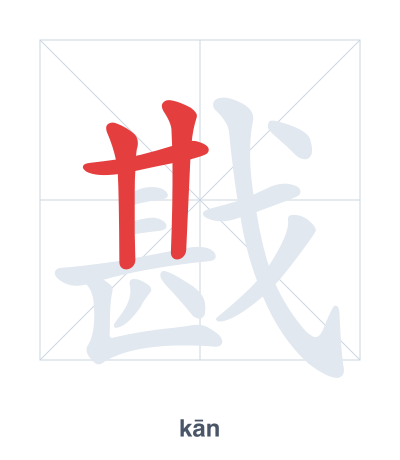
Open Hanzi Writer to see the animated stroke order and practice writing 戡 with real-time feedback.
The character 戡 (kān) is written with 13 strokes. Follow the standard Chinese stroke order: top to bottom, left to right, outside before inside. The radical 戈 is one of its key components.
Practice the correct stroke order with the Hanzi Writer app to see animated stroke-by-stroke guidance with real-time feedback.
戡 means To suppress; to quell; to put down..
戡 is a phono-semantic compound combining the radical 戈 (spear/weapon) and the phonetic component 甚. The weapon radical conveys the action of using force to suppress or quell, while 甚 provides pronunciation and may hint at the intensity of the suppression.
💡 Memory Tip: Imagine a knight with a spear (戈) plunging it into a very deep (甚) rebellion to suppress it completely.
军队负责戡乱。
jūn duì fù zé kān luàn
The army is responsible for suppressing the rebellion.
叛乱很快被戡定了。
pàn luàn hěn kuài bèi kān dìng le
The rebellion was quickly suppressed.
动乱终于被戡平了。
dòng luàn zhōng yú bèi kān píng le
The turmoil was finally suppressed.
Open Hanzi Writer to see the animated stroke order and practice writing 戡 with real-time feedback.
✨ Animated stroke order · Handwriting recognition · HSK-graded practice · Free to use
戡 is a phono-semantic compound. The left part 甚 (shèn) gives a clue to its pronunciation, and the right part 戈 (gē) means "spear" or "weapon," which connects to the idea of using force to suppress or quell.