馂 (jùn) means "Remains of a meal" in Chinese. It has 10 strokes with the radical 饣.
Rated 4.2/5 in difficulty (advanced).
Appears in 3+ common words including 馂余 (jùn yú), 馂馐 (jùn xiū), 馂熟 (jùn shú).
Due to its 10 strokes, Hanzi Writer's error detection shows 馂 requires focused practice — most learners need 10+ attempts for consistent accuracy.
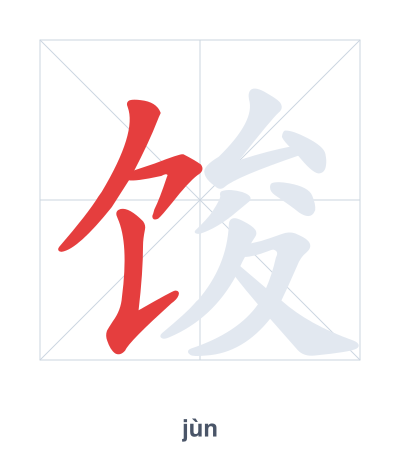
Open Hanzi Writer to see the animated stroke order and practice writing 馂 with real-time feedback.
The character 馂 (jùn) is written with 10 strokes. Follow the standard Chinese stroke order: top to bottom, left to right, outside before inside. The radical 饣 is one of its key components.
Practice the correct stroke order with the Hanzi Writer app to see animated stroke-by-stroke guidance with real-time feedback.
馂 means Remains of a meal.
The character 馂 combines the food radical 饣 (meaning 'food' or 'meal') with 夋, a component that phonetically suggests 'to shrink' or 'to diminish'. Together, they depict food that has been reduced or leftover, hence the meaning 'remains of a meal'. This structure reflects the idea of a meal after most has been consumed, leaving only scraps.
💡 Memory Tip: Imagine a plate of food (饣) that has been mostly eaten, with only a few scraps remaining, and the leftover bits are shrinking away (夋) as if disappearing.
他吃完了馂余。
tā chī wán le jùn yú
He finished the leftovers.
这些是美味的馂馐。
zhè xiē shì měi wèi de jùn xiū
These are delicious delicacies.
食物已经馂熟了。
shí wù yǐ jīng jùn shú le
The food is already cooked.
Open Hanzi Writer to see the animated stroke order and practice writing 馂 with real-time feedback.
✨ Animated stroke order · Handwriting recognition · HSK-graded practice · Free to use
馂 is made of the food radical 饣 (shí) on the left and the phonetic component 夋 (jùn) on the right. The radical shows it is related to food or eating, while 夋 originally meant "to cook thoroughly" and gives the sound. Together they describe the remains of a meal, or leftovers.