捃 (jùn) means "to collect; to gather" in Chinese. It has 10 strokes with the radical 扌.
Rated 4.2/5 in difficulty (advanced).
Appears in 3+ common words including 捃拾 (jùn shí), 捃摭 (jùn zhí), 捃采 (jùn cǎi).
Due to its 10 strokes, Hanzi Writer's error detection shows 捃 requires focused practice — most learners need 10+ attempts for consistent accuracy.
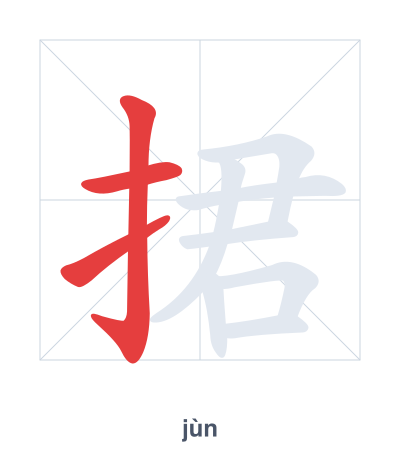
Open Hanzi Writer to see the animated stroke order and practice writing 捃 with real-time feedback.
The character 捃 (jùn) is written with 10 strokes. Follow the standard Chinese stroke order: top to bottom, left to right, outside before inside. The radical 扌 is one of its key components.
Practice the correct stroke order with the Hanzi Writer app to see animated stroke-by-stroke guidance with real-time feedback.
捃 means to collect; to gather.
捃 is a phono-semantic compound: the hand radical 扌 indicates the action of gathering or collecting, while 君 (lord) provides the pronunciation jùn. The character suggests a hand performing the act of gathering things together.
💡 Memory Tip: Picture a lord (君) using his hand (扌) to gather up scattered treasures from the ground.
他在田野里捃拾麦穗。
tā zài tián yě lǐ jùn shí mài suì
He is gleaning ears of wheat in the field.
这本书捃摭了许多史料。
zhè běn shū jùn zhí le xǔ duō shǐ liào
This book collects many historical materials.
捃采民间的歌谣。
jùn cǎi mín jiān de gē yáo
Collect folk songs.
Open Hanzi Writer to see the animated stroke order and practice writing 捃 with real-time feedback.
✨ Animated stroke order · Handwriting recognition · HSK-graded practice · Free to use
捃 is made of two parts: the left radical 扌 (hand) and the right component 君 (jūn, meaning lord). The hand radical shows an action, and although 君 does not directly mean “collect,” it provides the pronunciation clue and suggests a person gathering things, such as a lord collecting tributes. Together, they indicate the act of gathering or picking up items by hand.