镌 (juān) means "To engrave / To carve" in Chinese. It has 15 strokes with the radical 钅.
Rated 4.2/5 in difficulty (advanced).
Appears in 3+ common words including 镌刻 (juān kè), 镌字 (juān zì), 镌名 (juān míng).
Due to its 15 strokes, Hanzi Writer's error detection shows 镌 requires focused practice — most learners need 10+ attempts for consistent accuracy.
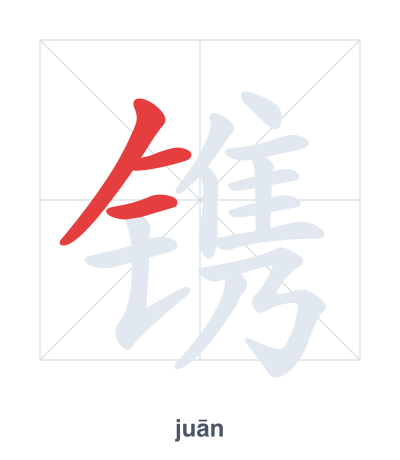
Open Hanzi Writer to see the animated stroke order and practice writing 镌 with real-time feedback.
The character 镌 (juān) is written with 15 strokes. Follow the standard Chinese stroke order: top to bottom, left to right, outside before inside. The radical 钅 is one of its key components.
Practice the correct stroke order with the Hanzi Writer app to see animated stroke-by-stroke guidance with real-time feedback.
镌 means To engrave / To carve.
This character is a phono-semantic compound. The left radical 钅 (metal) symbolizes a carving tool, while the right component 隽 (juàn, meaning 'talented' but containing 隹 'bird') provides the sound and hints at the fine artistry of engraving.
💡 Memory Tip: Imagine a metal engraving tool (钅) meticulously carving the elegant shape of a bird (隽) into a stone tablet.
碑上镌刻着历史。
bēi shàng juān kè zhe lì shǐ
History is engraved on the stele.
他在石头上镌字。
tā zài shí tou shàng juān zì
He is engraving characters on the stone.
奖杯上镌名了。
jiǎng bēi shàng juān míng le
The name has been engraved on the trophy.
Open Hanzi Writer to see the animated stroke order and practice writing 镌 with real-time feedback.
✨ Animated stroke order · Handwriting recognition · HSK-graded practice · Free to use
镌 is made of the radical 钅 (meaning metal) on the left and the phonetic component 隽 on the right. The metal radical connects to the action of carving or engraving, which is done with metal tools. The right part gives a hint to the pronunciation juān.