Hanzi Writer

How to Write 鞫 (jū) — Meaning “To interrogate”

18 strokes Radical: 革

鞫 (jū) means "To interrogate" in Chinese. It has 18 strokes with the radical 革.

Rated 4.2/5 in difficulty (advanced).

Appears in 3+ common words including 鞫讯 (jū xùn), 鞫问 (jū wèn), 鞫审 (jū shěn).

Due to its 18 strokes, Hanzi Writer's error detection shows 鞫 requires focused practice — most learners need 10+ attempts for consistent accuracy.
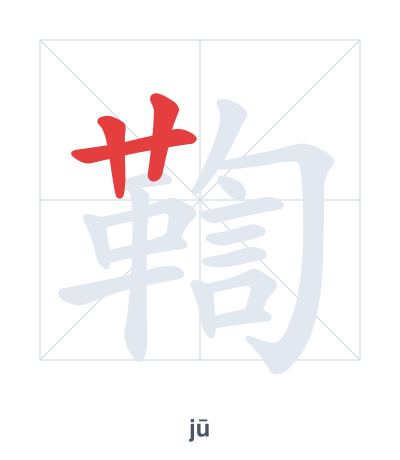
Stroke order practice for 鞫 - jū

Practice Writing 鞫 (jū)

Open Hanzi Writer to see the animated stroke order and practice writing 鞫 with real-time feedback.

The character (jū) is written with 18 strokes. Follow the standard Chinese stroke order: top to bottom, left to right, outside before inside. The radical is one of its key components.

Practice the correct stroke order with the Hanzi Writer app to see animated stroke-by-stroke guidance with real-time feedback.

means To interrogate.

Character
Pinyinjū (ju)
MeaningTo interrogate
Strokes18
Radical
Difficulty4.2/5

鞫 combines the radical 革 (leather) with the phonetic component 匊 (jū, meaning 'to hold in the hands'). In ancient China, interrogations often involved leather restraints or whips, so the leather radical hints at the coercive context, while 匊 suggests the act of 'grasping' the truth from a suspect.

💡 Memory Tip: Picture a leather-clad judge (革) squeezing (匊) a confession out of a prisoner by literally holding their head in both hands.

jū xùn
To interrogate
jū wèn
To interrogate
jū shěn
To interrogate and judge

法官正在鞫讯犯人。

fǎ guān zhèng zài jū xùn fàn rén

The judge is interrogating the prisoner.

警察在鞫问嫌疑人。

jǐng chá zài jū wèn xián yí rén

The police are interrogating the suspect.

案件正在鞫审中。

àn jiàn zhèng zài jū shěn zhōng

The case is currently under trial.

Character Pinyin Strokes Radical
(current) 18
mán 16
qiào 16
17
Stroke order practice for 鞫 - jū

Practice Writing 鞫 (jū)

Open Hanzi Writer to see the animated stroke order and practice writing 鞫 with real-time feedback.

✨ Animated stroke order · Handwriting recognition · HSK-graded practice · Free to use

Frequently Asked Questions about 鞫

The character 鞫 is composed of the radical 革 (leather) on the left and the phonetic component 匊 on the right. The radical 革 suggests a connection to leather, which was historically used in restraints during interrogations. The right side 匊 provides the pronunciation jū and hints at the idea of "holding" or "restraining" a suspect for questioning.

Characters with Radical 革

Other 18-Stroke Characters