裾 (jū) means "the hem of a robe; the tail of a coat" in Chinese. It has 13 strokes with the radical 衤.
Rated 4.2/5 in difficulty (advanced).
Appears in 3+ common words including 裙裾 (qún jū), 衣裾 (yī jū), 长裾 (zhǎng jū).
Due to its 13 strokes, Hanzi Writer's error detection shows 裾 requires focused practice — most learners need 10+ attempts for consistent accuracy.
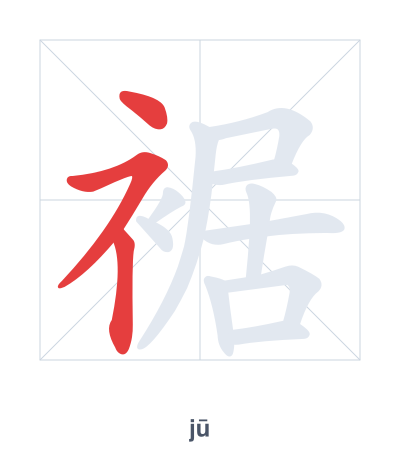
Open Hanzi Writer to see the animated stroke order and practice writing 裾 with real-time feedback.
The character 裾 (jū) is written with 13 strokes. Follow the standard Chinese stroke order: top to bottom, left to right, outside before inside. The radical 衤 is one of its key components.
Practice the correct stroke order with the Hanzi Writer app to see animated stroke-by-stroke guidance with real-time feedback.
裾 means the hem of a robe; the tail of a coat.
This phono-semantic compound combines the clothing radical 衤 (衣) with 居 (jū) as a phonetic component. The radical indicates it relates to garments, while the meaning 'hem' or 'tail of a coat' refers to the lower edge of a robe.
💡 Memory Tip: Picture a robe (衤) with a long hem trailing behind, and a tiny house (居) perched on the tail where a mouse resides.
她的裙裾随风飘动。
tā de qún jū suí fēng piāo dòng
The hem of her skirt fluttered in the wind.
他轻轻拉住了我的衣裾。
tā qīng qīng lā zhù le wǒ de yī jū
He gently pulled at the hem of my clothes.
这件礼服有很长的长裾。
zhè jiàn lǐ fú yǒu hěn zhǎng de zhǎng jū
This formal dress has a very long train.
Open Hanzi Writer to see the animated stroke order and practice writing 裾 with real-time feedback.
✨ Animated stroke order · Handwriting recognition · HSK-graded practice · Free to use
The left component is the radical 衤, which means "clothing," indicating that the character relates to garments. The right component 居 (jū) provides the pronunciation and does not directly contribute to the meaning. Together, 裾 specifically refers to the hem or tail of a robe.