疽 (jū) means "carbuncle" in Chinese. It has 10 strokes with the radical 疒.
Rated 4.2/5 in difficulty (advanced).
Appears in 3+ common words including 痈疽 (yōng jū), 疽毒 (jū dú), 疽肿 (jū zhǒng).
Due to its 10 strokes, Hanzi Writer's error detection shows 疽 requires focused practice — most learners need 10+ attempts for consistent accuracy.
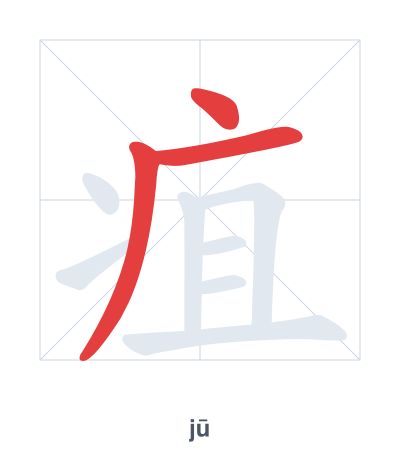
Open Hanzi Writer to see the animated stroke order and practice writing 疽 with real-time feedback.
The character 疽 (jū) is written with 10 strokes. Follow the standard Chinese stroke order: top to bottom, left to right, outside before inside. The radical 疒 is one of its key components.
Practice the correct stroke order with the Hanzi Writer app to see animated stroke-by-stroke guidance with real-time feedback.
疽 means carbuncle.
The character 疽 is a phono-semantic compound: the radical 疒 (sickness) indicates a disease, while 且 (jū) serves as the phonetic component. It specifically denotes a deep, severe skin abscess known as a carbuncle.
💡 Memory Tip: Imagine a sick person (疒) with a box-shaped lump (且) on their back that oozes pus like a painful carbuncle.
他的伤口成了痈疽。
tā de shāng kǒu chéng le yōng jū
His wound became an abscess.
疽毒扩散了。
jū dú kuò sàn le
The carbuncle infection has spread.
疽肿需要及时治疗。
jū zhǒng xū yào jí shí zhì liáo
Carbuncle swelling needs timely treatment.
Open Hanzi Writer to see the animated stroke order and practice writing 疽 with real-time feedback.
✨ Animated stroke order · Handwriting recognition · HSK-graded practice · Free to use
The character 疽 is composed of the radical 疒 (nè) on the left, which means illness or sickness, and the component 且 (qiě) on the right, which provides the pronunciation. Together, the structure shows that 疽 is a type of skin disease, specifically a carbuncle or deep ulcer.