痉 (jìng) means "spasm; convulsion" in Chinese. It has 10 strokes with the radical 疒.
Rated 4.2/5 in difficulty (advanced).
Appears in 3+ common words including 痉挛 (jìng luán), 抽痉 (chōu jìng), 痉笑 (jìng xiào).
Due to its 10 strokes, Hanzi Writer's error detection shows 痉 requires focused practice — most learners need 10+ attempts for consistent accuracy.
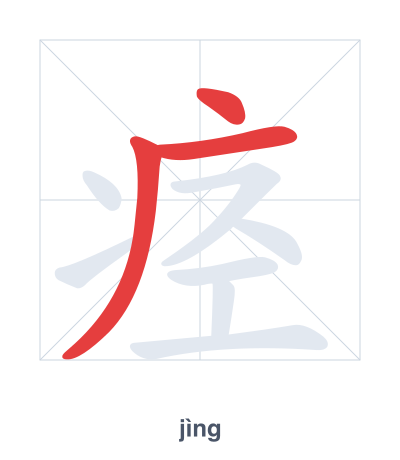
Open Hanzi Writer to see the animated stroke order and practice writing 痉 with real-time feedback.
The character 痉 (jìng) is written with 10 strokes. Follow the standard Chinese stroke order: top to bottom, left to right, outside before inside. The radical 疒 is one of its key components.
Practice the correct stroke order with the Hanzi Writer app to see animated stroke-by-stroke guidance with real-time feedback.
痉 means spasm; convulsion.
This character combines the 'illness' radical 疒 with the phonetic component 巠 (jīng), which originally depicted the warp threads on a loom. The taut, stretched threads evoke the muscular tightness and involuntary contraction of a spasm or convulsion.
💡 Memory Tip: Picture a patient on a sickbed (疒) whose limbs jerk uncontrollably, like the tight, vibrating warp threads (巠) of a loom.
他的腿突然发生了痉挛。
tā de tuǐ tū rán fā shēng le jìng luán
His leg suddenly cramped.
游泳时要注意别抽痉。
yóu yǒng shí yào zhù yì bié chōu jìng
Be careful not to get cramps while swimming.
这种病会导致面部痉笑。
zhè zhǒng bìng huì dǎo zhì miàn bù jìng xiào
This disease can cause a sardonic grin.
Open Hanzi Writer to see the animated stroke order and practice writing 痉 with real-time feedback.
✨ Animated stroke order · Handwriting recognition · HSK-graded practice · Free to use
痉 consists of the radical 疒 (sickness) on the outside and the phonetic component 巠 (jīng) inside. The radical indicates the character relates to illness or disease, while 巠 provides the pronunciation and suggests tension, together giving the meaning of muscle spasm or convulsion.