矜 (jīn) means "to boast; to restrain; to pity" in Chinese. It has 9 strokes with the radical 矛.
Rated 3.6/5 in difficulty (challenging).
Appears in 3+ common words including 矜持 (jīn chí), 矜夸 (jīn kuā), 哀矜 (āi jīn).
Due to its 9 strokes, Hanzi Writer's error detection shows 矜 requires focused practice — most learners need 10+ attempts for consistent accuracy.
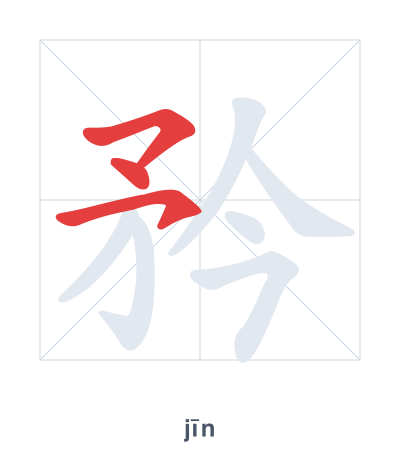
Open Hanzi Writer to see the animated stroke order and practice writing 矜 with real-time feedback.
The character 矜 (jīn) is written with 9 strokes. Follow the standard Chinese stroke order: top to bottom, left to right, outside before inside. The radical 矛 is one of its key components.
Practice the correct stroke order with the Hanzi Writer app to see animated stroke-by-stroke guidance with real-time feedback.
矜 means to boast; to restrain; to pity.
| Character | 矜 |
| Pinyin | jīn (jin) |
| Meaning | to boast; to restrain; to pity |
| Strokes | 9 |
| Radical | 矛 |
| Difficulty | 3.6/5 |
矜 is a compound character with the radical 矛 (spear) indicating weaponry, and the phonetic component 今 (jīn, 'now'). Its original meaning was 'handle of a spear', evolving to 'to grasp' or 'to hold oneself proudly', which led to the three meanings: 'to boast' (proud display), 'to restrain' (self-control), and 'to pity' (compassionate restraint).
💡 Memory Tip: Picture a soldier (矛) who today (今) boasts about his victories, then restrains himself and shows pity to a defeated enemy.
她在生人面前很矜持。
tā zài shēng rén miàn qián hěn jīn chí
She is very reserved in front of strangers.
取得成绩不要矜夸。
qǔ dé chéng jì bú yào jīn kuā
Do not boast when you achieve success.
我们要哀矜孤苦。
wǒ men yào āi jīn gū kǔ
We should show compassion for the lonely and miserable.
Open Hanzi Writer to see the animated stroke order and practice writing 矜 with real-time feedback.
✨ Animated stroke order · Handwriting recognition · HSK-graded practice · Free to use
矜 is made of two parts: the left side is 矛 (spear) and the right side is 今 (now). The spear radical gives a sense of strength or weapon, while 今 hints at the pronunciation. The combined meanings—to restrain, to boast, or to pity—come from the idea of handling a spear carefully, either holding back or showing off.