诘 (jié) means "To question; to interrogate" in Chinese. It has 8 strokes with the radical 讠.
Rated 3.4/5 in difficulty (challenging).
Appears in 3+ common words including 诘问 (jié wèn), 反诘 (fǎn jié), 诘责 (jié zé).
Due to its 8 strokes, Hanzi Writer's error detection shows 诘 requires focused practice — most learners need 10+ attempts for consistent accuracy.
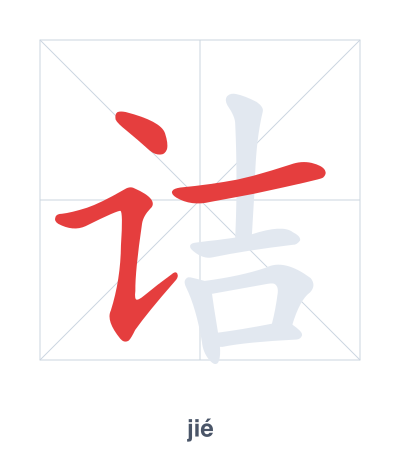
Open Hanzi Writer to see the animated stroke order and practice writing 诘 with real-time feedback.
The character 诘 (jié) is written with 8 strokes. Follow the standard Chinese stroke order: top to bottom, left to right, outside before inside. The radical 讠 is one of its key components.
Practice the correct stroke order with the Hanzi Writer app to see animated stroke-by-stroke guidance with real-time feedback.
诘 means To question; to interrogate.
诘 is a phono-semantic compound. The radical 讠 (simplified 言, 'speech') indicates the meaning relates to speaking or interrogating, while the component 吉 (jí, 'auspicious') provides the phonetic clue. Together they depict the act of questioning someone to get to the truth.
💡 Memory Tip: Picture a speech bubble (讠) demanding answers from a 'good' person (吉) in a tense interrogation.
老师在诘问那个学生。
lǎo shī zài jié wèn nà ge xué shēng
The teacher is questioning that student.
他提出了一个反诘。
tā tí chū le yí gè fǎn jié
He raised a counter-question.
他受到了严厉的诘责。
tā shòu dào le yán lì de jié zé
He was severely questioned and rebuked.
Open Hanzi Writer to see the animated stroke order and practice writing 诘 with real-time feedback.
✨ Animated stroke order · Handwriting recognition · HSK-graded practice · Free to use
诘 is made of the speech radical 讠 on the left and the character 吉 (jí, meaning lucky) on the right. The radical 讠 shows that the meaning is related to words or speaking, while 吉 provides a phonetic clue for the pronunciation jié. Together, they suggest using language to question or interrogate someone closely.