桔 (jié/jú) means "Tangerine / Orange" in Chinese. It has 10 strokes with the radical 木.
Rated 4.2/5 in difficulty (advanced).
Appears in 3+ common words including 桔子 (jú zi), 桔汁 (jú zhī), 桔梗 (jié gěng).
Due to its 10 strokes, Hanzi Writer's error detection shows 桔 requires focused practice — most learners need 10+ attempts for consistent accuracy.
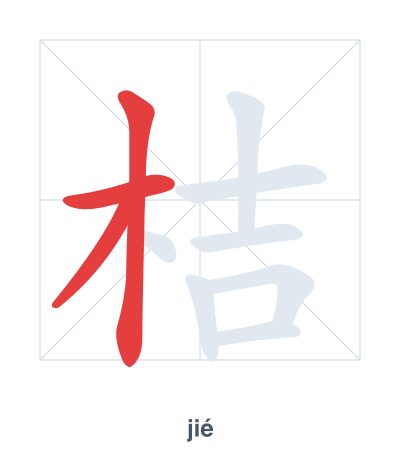
Open Hanzi Writer to see the animated stroke order and practice writing 桔 with real-time feedback.
The character 桔 (jié/jú) is written with 10 strokes. Follow the standard Chinese stroke order: top to bottom, left to right, outside before inside. The radical 木 is one of its key components.
Practice the correct stroke order with the Hanzi Writer app to see animated stroke-by-stroke guidance with real-time feedback.
桔 means Tangerine / Orange.
This is a polyphonic character with readings: jié, jú.
桔 combines the radical 木 (tree) with 吉 (auspicious), indicating a tree that bears tangerines—a fruit often associated with good luck in Chinese culture. The character originally referred to the tangerine plant, with 木 showing it's a type of tree and 吉 adding the sound jié as well as a hint of the fruit's fortunate symbolism.
💡 Memory Tip: Imagine a tangerine tree (木) growing bright orange fruits that each have the lucky character 吉 stamped on their peel.
这个桔子很甜。
zhè ge jú zi hěn tián
This orange is very sweet.
我想喝一杯桔汁。
wǒ xiǎng hē yī bēi jú zhī
I want to drink a glass of tangerine juice.
桔梗是一种中药材。
jié gěng shì yī zhǒng zhōng yào cái
Platycodon is a type of Chinese herbal medicine.
Open Hanzi Writer to see the animated stroke order and practice writing 桔 with real-time feedback.
✨ Animated stroke order · Handwriting recognition · HSK-graded practice · Free to use
The character 桔 is made of the radical 木 (wood/tree) on the left, showing it relates to plants or fruit. The right part is 吉 (jí, meaning lucky), which gives a hint to the pronunciation and also suggests that tangerines are considered lucky fruits in Chinese culture.