梗 (gěng) means "Stalk, stem, or main point" in Chinese. It has 11 strokes with the radical 木.
Rated 4.2/5 in difficulty (advanced).
Appears in 3+ common words including 梗概 (gěng gài), 玩梗 (wán gěng), 心梗 (xīn gěng).
Due to its 11 strokes, Hanzi Writer's error detection shows 梗 requires focused practice — most learners need 10+ attempts for consistent accuracy.
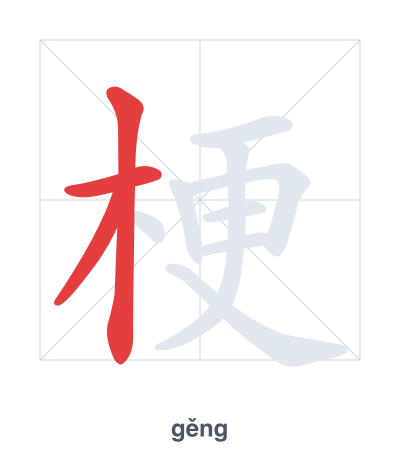
Open Hanzi Writer to see the animated stroke order and practice writing 梗 with real-time feedback.
The character 梗 (gěng) is written with 11 strokes. Follow the standard Chinese stroke order: top to bottom, left to right, outside before inside. The radical 木 is one of its key components.
Practice the correct stroke order with the Hanzi Writer app to see animated stroke-by-stroke guidance with real-time feedback.
梗 means Stalk, stem, or main point.
梗 is a phono-semantic compound: the radical 木 (tree/wood) indicates its plant-related meaning as a stalk or stem, while 更 (gèng, meaning 'change') provides the sound. In ancient usage, a '梗' was the woody stem of a plant, and by extension it came to mean the 'main point' or 'gist' of something, like the central stem that holds everything together.
💡 Memory Tip: Imagine a tree (木) that suddenly changes (更) into a giant stalk—the main point is to grab that stem!
请说一下故事的梗概。
qǐng shuō yī xià gù shì de gěng gài
Please give a brief summary of the story.
年轻人喜欢在网上玩梗。
nián qīng rén xǐ huān zài wǎng shàng wán gěng
Young people like to use internet memes.
他因为心梗住院了。
tā yīn wèi xīn gěng zhù yuàn le
He was hospitalized due to a heart attack.
Open Hanzi Writer to see the animated stroke order and practice writing 梗 with real-time feedback.
✨ Animated stroke order · Handwriting recognition · HSK-graded practice · Free to use
The character 梗 is made of the radical 木 (wood or tree) on the left and the phonetic component 更 on the right. The 木 radical connects it to plants, giving the original meaning of "stalk" or "stem." The right side 更 provides the pronunciation gěng and hints at the idea of a main point or core.