徨 (huáng) means "Agitated; irresolute (bound morpheme)." in Chinese. It has 12 strokes with the radical 彳.
Rated 4.2/5 in difficulty (advanced).
Appears in 3+ common words including 彷徨 (páng huáng), 徨徨 (huáng huáng), 彷徨失措 (páng huáng shī cuò).
Due to its 12 strokes, Hanzi Writer's error detection shows 徨 requires focused practice — most learners need 10+ attempts for consistent accuracy.
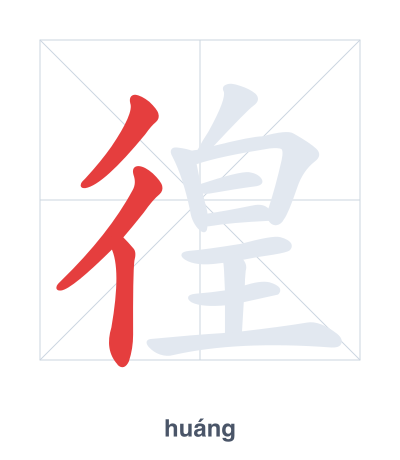
Open Hanzi Writer to see the animated stroke order and practice writing 徨 with real-time feedback.
The character 徨 (huáng) is written with 12 strokes. Follow the standard Chinese stroke order: top to bottom, left to right, outside before inside. The radical 彳 is one of its key components.
Practice the correct stroke order with the Hanzi Writer app to see animated stroke-by-stroke guidance with real-time feedback.
徨 means Agitated; irresolute (bound morpheme)..
徨 combines the radical 彳 (step) with the phonetic component 皇 (emperor). The radical suggests movement, evoking the restless pacing of someone who is agitated or indecisive.
💡 Memory Tip: Imagine an emperor (皇) pacing back and forth (彳) anxiously, unable to make a decision.
他心里感到很彷徨。
tā xīn lǐ gǎn dào hěn páng huáng
He feels very hesitant and lost.
他整天徨徨不安。
tā zhěng tiān huáng huáng bù ān
He is restless and uneasy all day long.
他在路口彷徨失措。
tā zài lù kǒu páng huáng shī cuò
He was lost and hesitant at the intersection.
Open Hanzi Writer to see the animated stroke order and practice writing 徨 with real-time feedback.
✨ Animated stroke order · Handwriting recognition · HSK-graded practice · Free to use
徨 is a left-right character. The left component 彳 (radical meaning 'step') suggests walking or movement, while the right component 皇 (huáng, 'emperor') gives the pronunciation. Together, the character conveys the idea of walking hesitantly or feeling agitated, as if unsure which step to take.