蝴 (hú) means "Butterfly (character component)" in Chinese. It has 15 strokes with the radical 虫.
Rated 4.2/5 in difficulty (advanced).
Appears in 3+ common words including 蝴蝶 (hú dié), 蝴蝶结 (hú dié jié), 蝴蝶花 (hú dié huā).
Due to its 15 strokes, Hanzi Writer's error detection shows 蝴 requires focused practice — most learners need 10+ attempts for consistent accuracy.
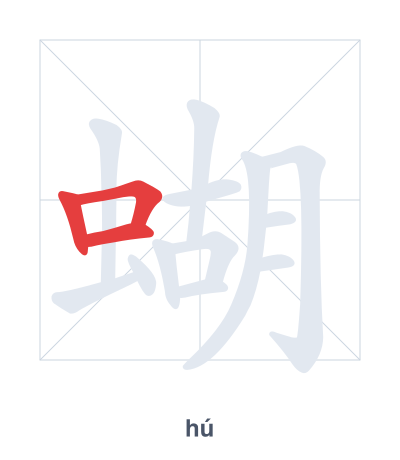
Open Hanzi Writer to see the animated stroke order and practice writing 蝴 with real-time feedback.
The character 蝴 (hú) is written with 15 strokes. Follow the standard Chinese stroke order: top to bottom, left to right, outside before inside. The radical 虫 is one of its key components.
Practice the correct stroke order with the Hanzi Writer app to see animated stroke-by-stroke guidance with real-time feedback.
蝴 means Butterfly (character component).
蝴 is a phono-semantic compound: the radical 虫 (insect) indicates it belongs to the insect category, and 胡 (hú) provides the pronunciation. The character specifically refers to butterflies, as seen in the word 蝴蝶 (húdié, butterfly).
💡 Memory Tip: Imagine a butterfly (虫) sporting a long, curly beard (胡) as it flutters through an ancient (古) moonlit (月) garden.
蝴蝶在花丛中飞舞。
hú dié zài huā cóng zhōng fēi wǔ
The butterfly is flying among the flowers.
她系了一个漂亮的蝴蝶结。
tā xì le yí gè piào liàng de hú dié jié
She tied a beautiful bow.
院子里种了很多蝴蝶花。
yuàn zi lǐ zhǒng le hěn duō hú dié huā
Many irises are planted in the yard.
Open Hanzi Writer to see the animated stroke order and practice writing 蝴 with real-time feedback.
✨ Animated stroke order · Handwriting recognition · HSK-graded practice · Free to use
The character 蝴 is made of the radical 虫 (insect) on the left and the phonetic component 胡 on the right. The 虫 radical indicates that the character is related to insects, which fits the meaning "butterfly." The 胡 part gives the pronunciation "hú" and does not contribute directly to the meaning.