蝶 (dié) means "Butterfly" in Chinese. It has 15 strokes with the radical 虫.
Rated 4.2/5 in difficulty (advanced).
Appears in 3+ common words including 蝶泳 (dié yǒng), 蝶形 (dié xíng), 化蝶 (huà dié).
Due to its 15 strokes, Hanzi Writer's error detection shows 蝶 requires focused practice — most learners need 10+ attempts for consistent accuracy.
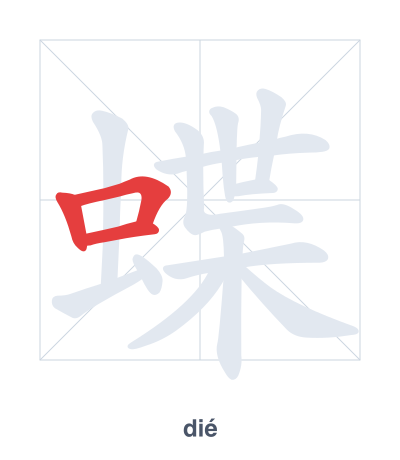
Open Hanzi Writer to see the animated stroke order and practice writing 蝶 with real-time feedback.
The character 蝶 (dié) is written with 15 strokes. Follow the standard Chinese stroke order: top to bottom, left to right, outside before inside. The radical 虫 is one of its key components.
Practice the correct stroke order with the Hanzi Writer app to see animated stroke-by-stroke guidance with real-time feedback.
蝶 means Butterfly.
蝶 is a compound character with the insect radical 虫 on the left and the phonetic component 枼 (yè) on the right, which originally depicted a flat leaf. The combination suggests an insect with broad, leaf-like wings—the butterfly.
💡 Memory Tip: Imagine a bug (虫) resting on a leaf (枼), its flat wings spread wide like the leaf itself—that's a butterfly.
他的蝶泳游得很快。
tā de dié yǒng yóu dé hěn kuài
He swims butterfly very fast.
这个桌子是蝶形的。
zhè ge zhuō zi shì dié xíng de
This table is butterfly-shaped.
这是一个化蝶的故事。
zhè shì yí gè huà dié de gù shì
This is a story of transforming into a butterfly.
Open Hanzi Writer to see the animated stroke order and practice writing 蝶 with real-time feedback.
✨ Animated stroke order · Handwriting recognition · HSK-graded practice · Free to use
The left side 虫 is the radical for insects, showing that a butterfly is an insect. The right side 枼 gives the sound "dié" and also resembles a leaf, which butterflies often rest on. Together, the parts mean "butterfly."