烘 (hōng) means "to bake; to dry by fire" in Chinese. It has 10 strokes with the radical 火, and is HSK Level 7.
Rated 4.2/5 in difficulty (advanced).
Harder than 70% of HSK Level 7 characters.
Appears in 3+ common words including 烘焙 (hōng bèi), 烘干 (hōng gān), 烘托 (hōng tuō).
Due to its 10 strokes, Hanzi Writer's error detection shows 烘 requires focused practice — most learners need 10+ attempts for consistent accuracy.
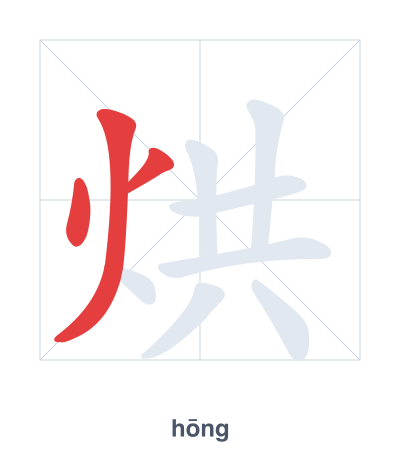
Open Hanzi Writer to see the animated stroke order and practice writing 烘 with real-time feedback.
The character 烘 (hōng) is written with 10 strokes. Follow the standard Chinese stroke order: top to bottom, left to right, outside before inside. The radical 火 is one of its key components.
Practice the correct stroke order with the Hanzi Writer app to see animated stroke-by-stroke guidance with real-time feedback.
烘 means to bake; to dry by fire.
As an HSK Level 7 character, 烘 is an intermediate-level character.
烘 is a phono-semantic compound: the left radical 火 (fire) indicates the meaning of heat or drying, while the right component 共 (gòng) originally depicted two hands holding an object and provides a phonetic hint for the pronunciation (though modern pinyin differs). In ancient usage, 共 also carries a sense of 'together' or 'supply,' aligning with the idea of applying fire to dry or bake something continuously.
💡 Memory Tip: Imagine a blazing fire (火) and two hands (共) holding food over it to bake it dry.
我喜欢烘焙蛋糕。
wǒ xǐ huān hōng bèi dàn gāo
I like baking cakes.
衣服已经烘干了。
yī fú yǐ jīng hōng gān le
The clothes have already been tumble-dried.
灯光烘托出气氛。
dēng guāng hōng tuō chū qì fēn
The lighting sets the atmosphere.
Open Hanzi Writer to see the animated stroke order and practice writing 烘 with real-time feedback.
✨ Animated stroke order · Handwriting recognition · HSK-graded practice · Free to use
烘 consists of the radical 火 (fire) on the left and the phonetic component 共 (gòng, common) on the right. The fire radical directly connects to the meaning of baking or drying by fire, while 共 hints at the pronunciation "hōng" though not exact. This left-right structure is typical for characters involving heat or fire.