焙 (bèi) means "to bake or dry over a slow fire" in Chinese. It has 12 strokes with the radical 火.
Rated 4.2/5 in difficulty (advanced).
Appears in 3+ common words including 烘焙 (hōng bèi), 焙干 (bèi gān), 烘焙店 (hōng bèi diàn).
Due to its 12 strokes, Hanzi Writer's error detection shows 焙 requires focused practice — most learners need 10+ attempts for consistent accuracy.
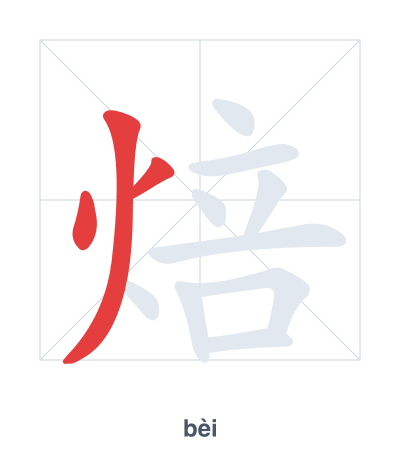
Open Hanzi Writer to see the animated stroke order and practice writing 焙 with real-time feedback.
The character 焙 (bèi) is written with 12 strokes. Follow the standard Chinese stroke order: top to bottom, left to right, outside before inside. The radical 火 is one of its key components.
Practice the correct stroke order with the Hanzi Writer app to see animated stroke-by-stroke guidance with real-time feedback.
焙 means to bake or dry over a slow fire.
焙 is a phono-semantic compound: the radical 火 (fire) on the left indicates the meaning relates to heat or fire, while the right component 咅 (originally a phonetic, but also suggesting blowing or spitting) hints at the pronunciation bèi. Together, they depict the process of drying or baking something over a slow fire.
💡 Memory Tip: Picture a fire (火) where you place food, and a person (from 咅's upper 口, mouth) gently blowing to maintain a low, steady heat for baking.
我喜欢烘焙蛋糕。
wǒ xǐ huān hōng bèi dàn gāo
I like baking cakes.
把茶叶焙干。
bǎ chá yè bèi gān
Roast the tea leaves dry.
烘焙店里很香。
hōng bèi diàn lǐ hěn xiāng
The bakery smells delicious.
Open Hanzi Writer to see the animated stroke order and practice writing 焙 with real-time feedback.
✨ Animated stroke order · Handwriting recognition · HSK-graded practice · Free to use
焙 is made of the radical 火 (fire) on the left and 咅 (pǒu) on the right. The fire radical directly shows that the meaning involves heat, while 咅 originally meant a sound but here acts as a phonetic component. Together, they form the idea of using fire to dry or bake something slowly.