鸻 (héng) means "Plover" in Chinese. It has 11 strokes with the radical 鸟.
Rated 4.2/5 in difficulty (advanced).
Appears in 3+ common words including 鸻鸟 (héng niǎo), 环颈鸻 (huán jǐng héng), 水鸻 (shuǐ héng).
Due to its 11 strokes, Hanzi Writer's error detection shows 鸻 requires focused practice — most learners need 10+ attempts for consistent accuracy.
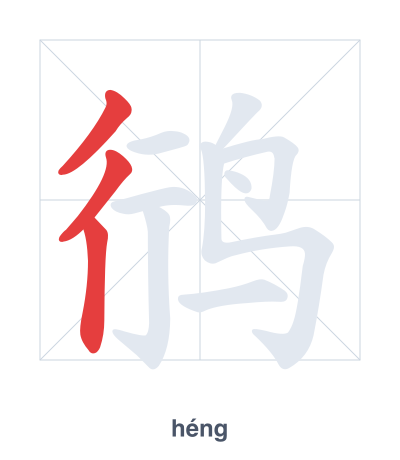
Open Hanzi Writer to see the animated stroke order and practice writing 鸻 with real-time feedback.
The character 鸻 (héng) is written with 11 strokes. Follow the standard Chinese stroke order: top to bottom, left to right, outside before inside. The radical 鸟 is one of its key components.
Practice the correct stroke order with the Hanzi Writer app to see animated stroke-by-stroke guidance with real-time feedback.
鸻 means Plover.
The character 鸻 combines 行 (héng, 'to walk') as a phonetic and semantic hint, with 鸟 (niǎo, 'bird') as the radical, depicting a bird known for walking along shorelines—the plover.
💡 Memory Tip: Picture a plover bird (鸟) marching in formation (行) across the sand, following a straight path.
鸻鸟在沙滩上走。
héng niǎo zài shā tān shàng zǒu
The plover is walking on the beach.
环颈鸻很小巧。
huán jǐng héng hěn xiǎo qiǎo
The ringed plover is very small and delicate.
水鸻喜欢在水边。
shuǐ héng xǐ huān zài shuǐ biān
Plovers like to be near the water.
Open Hanzi Writer to see the animated stroke order and practice writing 鸻 with real-time feedback.
✨ Animated stroke order · Handwriting recognition · HSK-graded practice · Free to use
The character 鸻 combines the left side 行 (héng, phonetic component) with the right side 鸟 (bird, semantic radical). The 鸟 radical indicates it is a type of bird, while 行 provides the sound. Together they form the name for the plover bird.