蚝 (háo) means "oyster" in Chinese. It has 10 strokes with the radical 虫.
Rated 4.2/5 in difficulty (advanced).
Appears in 3+ common words including 蚝油 (háo yóu), 生蚝 (shēng háo), 蚝油生菜 (háo yóu shēng cài).
Due to its 10 strokes, Hanzi Writer's error detection shows 蚝 requires focused practice — most learners need 10+ attempts for consistent accuracy.
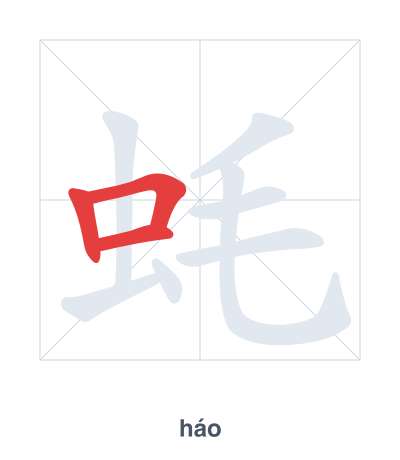
Open Hanzi Writer to see the animated stroke order and practice writing 蚝 with real-time feedback.
The character 蚝 (háo) is written with 10 strokes. Follow the standard Chinese stroke order: top to bottom, left to right, outside before inside. The radical 虫 is one of its key components.
Practice the correct stroke order with the Hanzi Writer app to see animated stroke-by-stroke guidance with real-time feedback.
蚝 means oyster.
蚝 is a compound character with 虫 (shellfish) as the semantic component and 毛 (hair) as the phonetic hint, also suggesting the rough, hairy texture of an oyster's shell.
💡 Memory Tip: Imagine a hairy bug (虫) wearing a fuzzy coat (毛) that looks like the rough shell of an oyster.
妈妈买了瓶蚝油。
mā mā mǎi le píng háo yóu
Mom bought a bottle of oyster sauce.
我喜欢吃生蚝。
wǒ xǐ huān chī shēng háo
I like eating oysters.
蚝油生菜很好吃。
háo yóu shēng cài hěn hǎo chī
Lettuce with oyster sauce is delicious.
Open Hanzi Writer to see the animated stroke order and practice writing 蚝 with real-time feedback.
✨ Animated stroke order · Handwriting recognition · HSK-graded practice · Free to use
The character 蚝 combines the radical 虫 (insect/worm) on the left with 毛 (hair/fur) on the right. The 虫 radical indicates this character relates to a small creature, specifically a shellfish like the oyster. The 毛 component originally suggested a rough or hairy surface, describing the oyster's rough shell.