筕 (háng) means "Bamboo pole or rack" in Chinese. It has 12 strokes with the radical 竹.
Rated 4.2/5 in difficulty (advanced).
Appears in 3+ common words including 筕篖 (háng táng), 竹筕 (zhú háng), 筕子 (háng zi).
Due to its 12 strokes, Hanzi Writer's error detection shows 筕 requires focused practice — most learners need 10+ attempts for consistent accuracy.
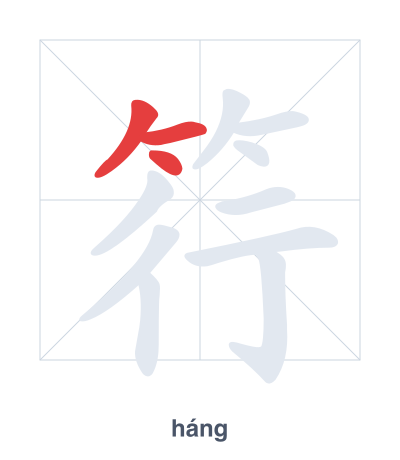
Open Hanzi Writer to see the animated stroke order and practice writing 筕 with real-time feedback.
The character 筕 (háng) is written with 12 strokes. Follow the standard Chinese stroke order: top to bottom, left to right, outside before inside. The radical 竹 is one of its key components.
Practice the correct stroke order with the Hanzi Writer app to see animated stroke-by-stroke guidance with real-time feedback.
筕 means Bamboo pole or rack.
The character 筕 combines the bamboo radical 竹, indicating the material, with 行 (háng, meaning 'row' or 'line'), suggesting a rack made of bamboo poles arranged in a line. This compound reflects the original meaning: a bamboo pole used as a support or a rack for hanging items.
💡 Memory Tip: Picture a bamboo pole (竹) that you carry as you walk (行) along a trail, then prop it up to use as a drying rack for your clothes.
筕篖在墙边。
háng táng zài qiáng biān
The bamboo container is by the wall.
这个竹筕很长。
zhè ge zhú háng hěn zhǎng
This bamboo pole is very long.
他拿了一个筕子。
tā ná le yí gè háng zi
He took a bamboo basket.
Open Hanzi Writer to see the animated stroke order and practice writing 筕 with real-time feedback.
✨ Animated stroke order · Handwriting recognition · HSK-graded practice · Free to use
筕 is composed of the radical 竹 (bamboo) on top and the component 行 (háng) below. The 竹 radical gives the meaning of bamboo, while 行 provides the pronunciation and hints at the idea of a long object, together forming 'bamboo pole or rack'.