诖 (guà) means "To involve; to hinder; to error" in Chinese. It has 8 strokes with the radical 讠.
Rated 3.4/5 in difficulty (challenging).
Appears in 3+ common words including 诖误 (guà wù), 诖碍 (guà ài), 诖乱 (guà luàn).
Due to its 8 strokes, Hanzi Writer's error detection shows 诖 requires focused practice — most learners need 10+ attempts for consistent accuracy.
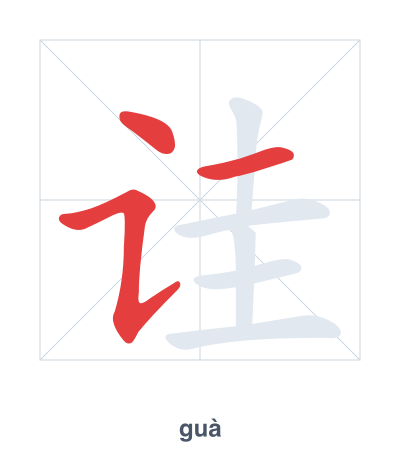
Open Hanzi Writer to see the animated stroke order and practice writing 诖 with real-time feedback.
The character 诖 (guà) is written with 8 strokes. Follow the standard Chinese stroke order: top to bottom, left to right, outside before inside. The radical 讠 is one of its key components.
Practice the correct stroke order with the Hanzi Writer app to see animated stroke-by-stroke guidance with real-time feedback.
诖 means To involve; to hinder; to error.
诖 is a phono-semantic compound where the radical 讠 (speech) indicates the meaning relates to words, and the component 圭 (guī, a jade tablet) contributes the sound. The original meaning 'to err' or 'to mislead' comes from speech leading to mistakes or entanglement, as if words become tangled like a hanging thread.
💡 Memory Tip: Imagine a jade tablet (圭) hanging from a speech bubble (讠), tripping someone up and causing an error or hindrance.
他无意中受到了诖误。
tā wú yì zhōng shòu dào le guà wù
He was accidentally misled or implicated.
心中没有任何诖碍。
xīn zhōng méi yǒu rèn hé guà ài
There are no worries or obstructions in the heart.
别被这些琐事诖乱。
bié bèi zhè xiē suǒ shì guà luàn
Don't be distracted by these trivial matters.
Open Hanzi Writer to see the animated stroke order and practice writing 诖 with real-time feedback.
✨ Animated stroke order · Handwriting recognition · HSK-graded practice · Free to use
诖 is composed of the radical 讠 (speech) on the left and the phonetic component 圭 (guī, a jade tablet) on the right. The speech radical suggests that the meaning involves words or communication, and the entire character conveys the idea of causing errors or hindrance through speech.