聒 (guā) means "noisy; clamorous" in Chinese. It has 12 strokes with the radical 耳.
Rated 4.2/5 in difficulty (advanced).
Appears in 3+ common words including 聒噪 (guā zào), 聒耳 (guā ěr), 聒吵 (guā chǎo).
Due to its 12 strokes, Hanzi Writer's error detection shows 聒 requires focused practice — most learners need 10+ attempts for consistent accuracy.
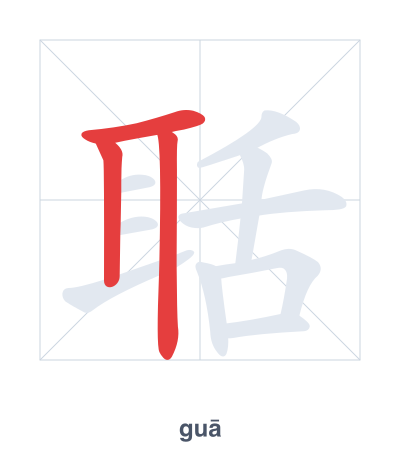
Open Hanzi Writer to see the animated stroke order and practice writing 聒 with real-time feedback.
The character 聒 (guā) is written with 12 strokes. Follow the standard Chinese stroke order: top to bottom, left to right, outside before inside. The radical 耳 is one of its key components.
Practice the correct stroke order with the Hanzi Writer app to see animated stroke-by-stroke guidance with real-time feedback.
聒 means noisy; clamorous.
| Character | 聒 |
| Pinyin | guā (gua) |
| Meaning | noisy; clamorous |
| Strokes | 12 |
| Radical | 耳 |
| Difficulty | 4.2/5 |
聒 combines the radical 耳 (ear) on the left with 舌 (tongue) on the right, suggesting a tongue (speech) that assails the ear. This composition directly conveys the meaning of loud, annoying noise or clamor.
💡 Memory Tip: A tongue (舌) wagging directly into your ear (耳) is so noisy you want to shout "Gwa!" (its sound) for it to stop.
这里的环境很聒噪。
zhè lǐ de huán jìng hěn guā zào
The environment here is very noisy and clamorous.
噪音非常聒耳。
zào yīn fēi cháng guā ěr
The noise is very grating on the ears.
别在这里聒吵。
bié zài zhè lǐ guā chǎo
Don't be noisy here.
Open Hanzi Writer to see the animated stroke order and practice writing 聒 with real-time feedback.
✨ Animated stroke order · Handwriting recognition · HSK-graded practice · Free to use
聒 combines the radical 耳 (ear) on the left with 舌 (tongue) on the right. Since ears hear noise and tongues produce sound, together they suggest a clamorous or grating noise that enters the ear.