蛊 (gǔ) means "poison; bewitch" in Chinese. It has 11 strokes with the radical 虫.
Rated 4.2/5 in difficulty (advanced).
Appears in 3+ common words including 蛊惑 (gǔ huò), 中蛊 (zhōng gǔ), 蛊毒 (gǔ dú).
Due to its 11 strokes, Hanzi Writer's error detection shows 蛊 requires focused practice — most learners need 10+ attempts for consistent accuracy.
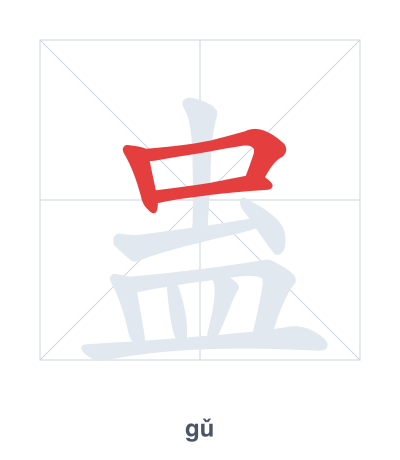
Open Hanzi Writer to see the animated stroke order and practice writing 蛊 with real-time feedback.
The character 蛊 (gǔ) is written with 11 strokes. Follow the standard Chinese stroke order: top to bottom, left to right, outside before inside. The radical 虫 is one of its key components.
Practice the correct stroke order with the Hanzi Writer app to see animated stroke-by-stroke guidance with real-time feedback.
蛊 means poison; bewitch.
The character 蛊 combines 虫 (insect) above and 皿 (vessel) below. In ancient China, a poison called 'gu' was made by sealing venomous insects in a container to fight each other; the survivor's concentrated venom represents both poison and bewitchment.
💡 Memory Tip: Picture a dish (皿) crawling with insects (虫) that brew a sinister poison—one sip and you're under a spell.
别被他蛊惑了。
bié bèi tā gǔ huò le
Don't be misled by him.
他好像中蛊了。
tā hǎo xiàng zhōng gǔ le
He seems to be under a spell.
传说中有蛊毒。
chuán shuō zhōng yǒu gǔ dú
Legend says there is a type of sorcery involving Gu poison.
Open Hanzi Writer to see the animated stroke order and practice writing 蛊 with real-time feedback.
✨ Animated stroke order · Handwriting recognition · HSK-graded practice · Free to use
蛊 consists of 虫 (insect) on top and 皿 (vessel) below. The original idea was poisonous insects placed in a vessel to create a sorcery poison, which connects to its meanings of poison and bewitchment.