瞽 (gǔ) means "blind; a blind person" in Chinese. It has 18 strokes with the radical 目.
Rated 4.2/5 in difficulty (advanced).
Appears in 3+ common words including 瞽者 (gǔ zhě), 瞽言 (gǔ yán), 瞽说 (gǔ shuō).
Due to its 18 strokes, Hanzi Writer's error detection shows 瞽 requires focused practice — most learners need 10+ attempts for consistent accuracy.
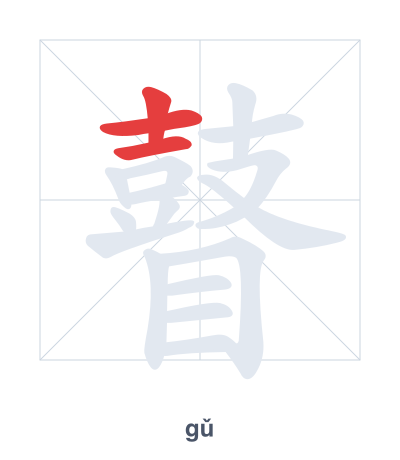
Open Hanzi Writer to see the animated stroke order and practice writing 瞽 with real-time feedback.
The character 瞽 (gǔ) is written with 18 strokes. Follow the standard Chinese stroke order: top to bottom, left to right, outside before inside. The radical 目 is one of its key components.
Practice the correct stroke order with the Hanzi Writer app to see animated stroke-by-stroke guidance with real-time feedback.
瞽 means blind; a blind person.
瞽 combines 目 (eye) and 鼓 (drum). Historically, blind musicians in ancient China often played drums, so the character depicts a person whose eyes are useless but whose connection to sound (drum) is emphasized. The eye radical signals the lack of sight, while the drum hints at the profession of many blind people.
💡 Memory Tip: Imagine a blind drummer whose eyes are covered by a drum (鼓) over the 目 — he can't see, but he can feel the beat.
瞽者在路边拉琴。
gǔ zhě zài lù biān lā qín
A blind person is playing a stringed instrument by the roadside.
这只是我的瞽言。
zhè zhǐ shì wǒ de gǔ yán
This is just my humble opinion.
别听那些瞽说。
bié tīng nà xiē gǔ shuō
Don't listen to those groundless rumors.
Open Hanzi Writer to see the animated stroke order and practice writing 瞽 with real-time feedback.
✨ Animated stroke order · Handwriting recognition · HSK-graded practice · Free to use
The character 瞽 combines 目 (eye) on top with 鼓 (drum) below. The eye radical directly relates to vision, while the drum component may suggest the idea of something covering or blocking sight, like a drum skin. This structure visually represents a blind person or blindness.