塥 (gé) means "dry, hard soil" in Chinese. It has 13 strokes with the radical 土.
Rated 4.2/5 in difficulty (advanced).
Appears in 3+ common words including 塥田 (gé tián), 塥土 (gé tǔ), 塥地 (gé dì).
Due to its 13 strokes, Hanzi Writer's error detection shows 塥 requires focused practice — most learners need 10+ attempts for consistent accuracy.
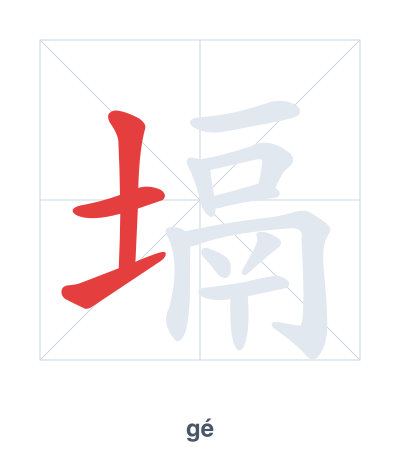
Open Hanzi Writer to see the animated stroke order and practice writing 塥 with real-time feedback.
The character 塥 (gé) is written with 13 strokes. Follow the standard Chinese stroke order: top to bottom, left to right, outside before inside. The radical 土 is one of its key components.
Practice the correct stroke order with the Hanzi Writer app to see animated stroke-by-stroke guidance with real-time feedback.
塥 means dry, hard soil.
塥 is a phono-semantic compound: the radical 土 (earth) indicates soil, while 鬲 (gé) — an ancient tripod cauldron often fired from clay into a hard, brittle state — gives the sound and hints at the hardened, dry quality of the soil.
💡 Memory Tip: Picture a parched field of 土 (earth) cracked into the shape of a 鬲 (tripod), so dry and hard that you could bake bread on it.
这块塥田需要浇水。
zhè kuài gé tián xū yào jiāo shuǐ
This dry field needs watering.
塥土非常干燥。
gé tǔ fēi cháng gān zào
The dry soil is very arid.
他在塥地上种庄稼。
tā zài gé dì shàng zhǒng zhuāng jià
He is planting crops on the dry, cracked land.
Open Hanzi Writer to see the animated stroke order and practice writing 塥 with real-time feedback.
✨ Animated stroke order · Handwriting recognition · HSK-graded practice · Free to use
The character 塥 is made of the radical 土 (earth) on the left, which shows it relates to soil or ground. The right part is 畐, which gives the sound and also suggests a packed or full shape, together indicating hard, dry earth.