缟 (gǎo) means "plain white silk" in Chinese. It has 13 strokes with the radical 纟.
Rated 4.2/5 in difficulty (advanced).
Appears in 3+ common words including 缟素 (gǎo sù), 缟衣 (gǎo yī), 缟带 (gǎo dài).
Due to its 13 strokes, Hanzi Writer's error detection shows 缟 requires focused practice — most learners need 10+ attempts for consistent accuracy.
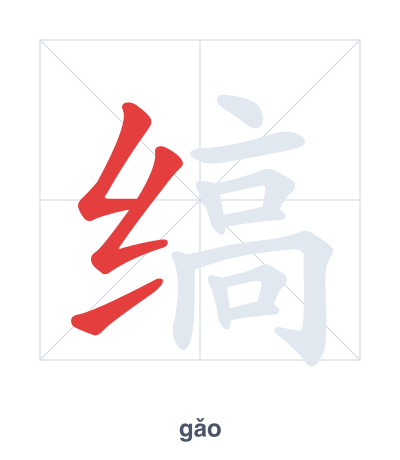
Open Hanzi Writer to see the animated stroke order and practice writing 缟 with real-time feedback.
The character 缟 (gǎo) is written with 13 strokes. Follow the standard Chinese stroke order: top to bottom, left to right, outside before inside. The radical 纟 is one of its key components.
Practice the correct stroke order with the Hanzi Writer app to see animated stroke-by-stroke guidance with real-time feedback.
缟 means plain white silk.
This character is a phonetic compound combining the silk radical 纟 (silk) with the phonetic component 高 (gǎo, meaning 'high' or 'tall'). The plain white silk was often associated with high-quality, unbleached fabric, possibly used for mourning or simple garments.
💡 Memory Tip: Imagine a tall pole (高) draped with a long, plain white silk cloth (纟) hanging straight down, stark and unadorned.
大家都穿着缟素。
dà jiā dōu chuān zhe gǎo sù
Everyone was dressed in white mourning clothes.
她穿着一件缟衣。
tā chuān zhe yī jiàn gǎo yī
She is wearing a plain white garment.
他系着白色缟带。
tā xì zhe bái sè gǎo dài
He was wearing a white silk belt.
Open Hanzi Writer to see the animated stroke order and practice writing 缟 with real-time feedback.
✨ Animated stroke order · Handwriting recognition · HSK-graded practice · Free to use
缟 is composed of the radical 纟 (silk thread) on the left, and the phonetic component 高 (gāo, tall) on the right. The radical indicates that the character relates to silk or textiles, while 高 gives the approximate pronunciation. Together they form the meaning 'plain white silk'.