槔 (gāo) means "Well-sweep" in Chinese. It has 14 strokes with the radical 木.
Rated 4.2/5 in difficulty (advanced).
Appears in 3+ common words including 桔槔 (jié gāo), 木槔 (mù gāo), 槔水 (gāo shuǐ).
Due to its 14 strokes, Hanzi Writer's error detection shows 槔 requires focused practice — most learners need 10+ attempts for consistent accuracy.
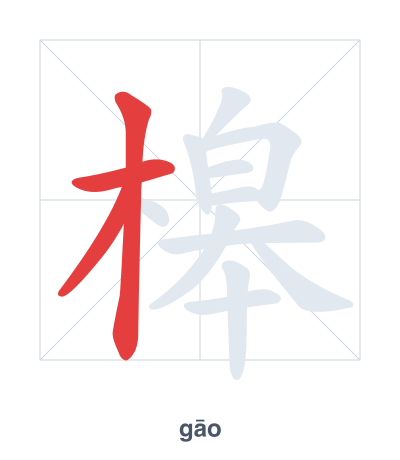
Open Hanzi Writer to see the animated stroke order and practice writing 槔 with real-time feedback.
The character 槔 (gāo) is written with 14 strokes. Follow the standard Chinese stroke order: top to bottom, left to right, outside before inside. The radical 木 is one of its key components.
Practice the correct stroke order with the Hanzi Writer app to see animated stroke-by-stroke guidance with real-time feedback.
槔 means Well-sweep.
槔 is a phono-semantic compound: the radical 木 (wood/tree) hints that the well-sweep was made of wood, while 皋 (gāo) provides the pronunciation. The character's structure combines 'wood' with a component that evokes height or lifting, matching the pole's motion.
💡 Memory Tip: Picture a wooden post (木) with a tall white bucket (白 on top of 本) swinging like a lever to scoop water from a well.
农民用桔槔从井里打水。
nóng mín yòng jié gāo cóng jǐng lǐ dǎ shuǐ
Farmers use a shadoof to draw water from the well.
这是一个古老的木槔。
zhè shì yí gè gǔ lǎo de mù gāo
This is an ancient well sweep.
他在学习如何使用槔水。
tā zài xué xí rú hé shǐ yòng gāo shuǐ
He is learning how to use a well sweep to draw water.
Open Hanzi Writer to see the animated stroke order and practice writing 槔 with real-time feedback.
✨ Animated stroke order · Handwriting recognition · HSK-graded practice · Free to use
槔 is made of the radical 木 (wood) on the left and 皋 (gāo) on the right. The 木 tells you it is made of wood, and 皋 gives the sound and hints at a high structure, because a well-sweep is a tall wooden lever used to lift water from a well.