澉 (gǎn) means "to wash or rinse" in Chinese. It has 14 strokes with the radical 氵.
Rated 4.2/5 in difficulty (advanced).
Appears in 3+ common words including 澉浦 (gǎn pǔ), 澉洗 (gǎn xǐ), 澉制 (gǎn zhì).
Due to its 14 strokes, Hanzi Writer's error detection shows 澉 requires focused practice — most learners need 10+ attempts for consistent accuracy.
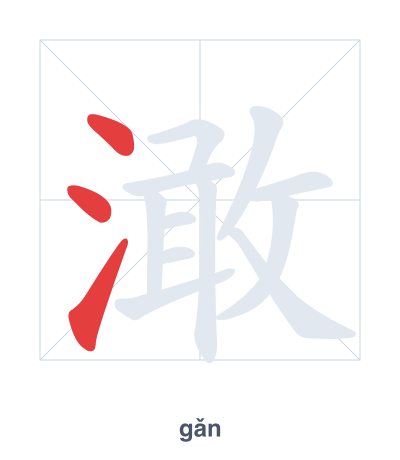
Open Hanzi Writer to see the animated stroke order and practice writing 澉 with real-time feedback.
The character 澉 (gǎn) is written with 14 strokes. Follow the standard Chinese stroke order: top to bottom, left to right, outside before inside. The radical 氵 is one of its key components.
Practice the correct stroke order with the Hanzi Writer app to see animated stroke-by-stroke guidance with real-time feedback.
澉 means to wash or rinse.
澉 is a compound character with the water radical (氵) indicating its association with liquids and washing. The right component 敢 (gǎn, meaning 'daring' or 'bold') serves as a phonetic hint, contributing the sound but not directly the meaning. The character thus conveys the action of rinsing or washing, as if boldly applying water to cleanse something.
💡 Memory Tip: Imagine a daring person (敢) using a bucket of water (氵) to bravely rinse off a sticky mess.
他在澉浦工作。
tā zài gǎn pǔ gōng zuò
He works in Ganpu.
把衣服澉洗一下。
bǎ yī fú gǎn xǐ yī xià
Give the clothes a quick rinse.
这是手工澉制的。
zhè shì shǒu gōng gǎn zhì de
This is handmade and hand-rolled.
Open Hanzi Writer to see the animated stroke order and practice writing 澉 with real-time feedback.
✨ Animated stroke order · Handwriting recognition · HSK-graded practice · Free to use
澉 is made of two parts: the radical 氵 (three dots) on the left, meaning water, and 敢 (gǎn) on the right, which gives the sound. The water radical directly connects to the character's meaning of washing or rinsing, which requires water.